
Reviewed · MADRID TUK TUK TOURS
Tour en tuk-tuk electrico por MADRID MODERNO
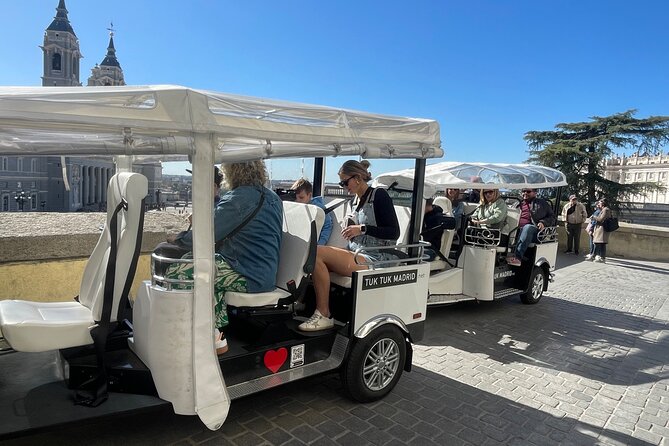
Madrid reveals itself quickly from the back of an electric tuk-tuk. In 90 minutes, you pass royal buildings, grand museums, old city gates, leafy avenues, luxury shops, and the bright signs of Gran Vía without spending the morning walking between them. It is a smart first look at a large city.
I like the private format for up to four people, which keeps the ride personal and lets your group focus on photos or ask for more detail. I also like the route’s range, from the Royal Palace and Almudena Cathedral to the Prado, Salamanca, and Las Ventas.
The main concern is reliability. Several bookings have involved a late or missing driver, so confirm the meeting details and contact the operator before setting out. Traffic noise can also make the guide hard to hear.
Key points at a glance
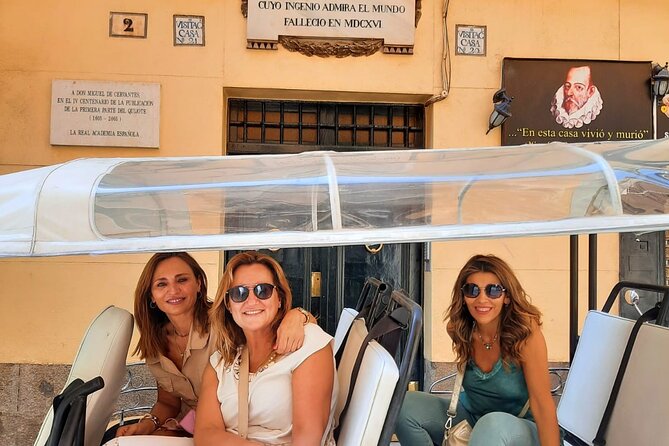
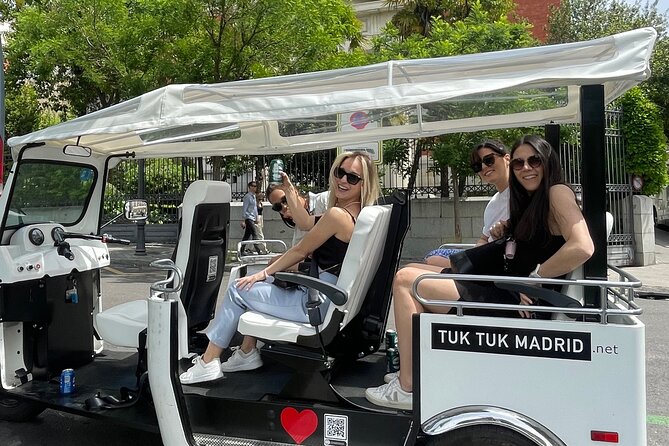
- Private electric tuk-tuk: Your group of up to four has the vehicle to itself.
- A broad Madrid route: The tour covers royal sights, art museums, historic gates, grand squares, and modern shopping streets.
- English-language guiding: Guides including Javier, Juan, Jimena, José, and George have led tours, though the assigned guide varies.
- Photo-focused stops: You can pause at the monuments for pictures and receive a short explanation rather than entering every site.
- Good first-day orientation: The route shows you where to return later for the Prado, Royal Palace, Retiro, or Salamanca.
- Simple value calculation: At $131.54 per group, the price makes more sense for four people than for one or two.
A fast, wide look at Madrid

This tour is built for orientation, not long museum visits. You ride through central Madrid while your guide points out buildings, explains their place in the city, and stops for photographs. It is a useful way to cover ground when your time is short or your feet need a break.
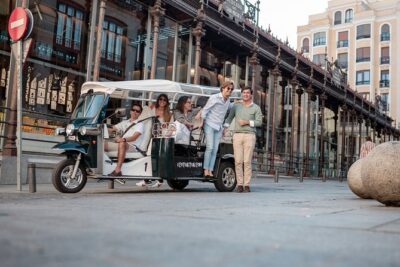
The vehicle is electric, so you get an open-air city view without the rumble of a standard sightseeing bus. The tradeoff is space. A tuk-tuk is intimate, and four adults may find it snug, especially with coats or day bags.
The start time is 9:00 a.m. at C. de Vergara, 1, near the Royal Palace area. Starting early gives you a head start on the day, though Madrid’s streets and traffic can still make conversation uneven. One French-language booking noted that passing traffic sometimes covered the guide’s voice, and an individual headset system would have helped.
Your guide is both driver and narrator. Names reported for this experience include Javier, Juan, Jimena, José, and George. The guide assigned to you may be different, but the strongest tours have been praised for clear English, friendly service, useful historical detail, and restaurant suggestions.
More Madrid Tuk Tuk Tours:
- Madrid Welcome Tour with Local Guide in Eco Tuk Tuk Private
★ 5.0 · 2,936 reviews - Madrid: Private City Tour by Eco Tuk Tuk
★ 4.9 · 2,876 reviews - Madrid Historical Tour with Local Guide in Eco Tuk Tuk Private
★ 5.0 · 876 reviews
Royal Madrid begins at the palace
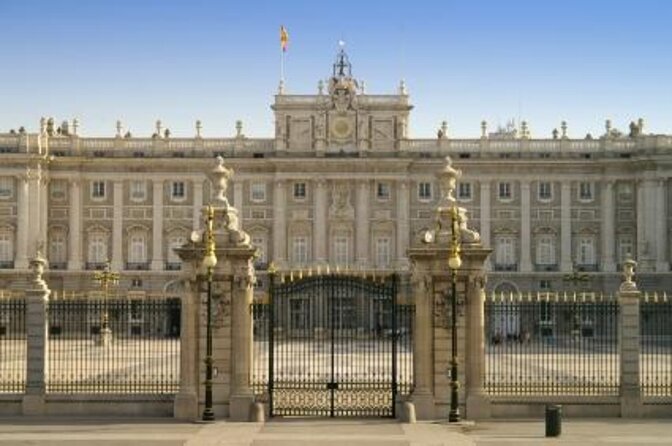
The Royal Palace of Madrid is the natural opening point. It is the official residence of the King of Spain and one of the largest royal palaces in Western Europe, with 3,418 rooms spread across about 135,000 square meters.
You will not tour all those rooms during this experience. Instead, expect an exterior introduction, a few facts, and time for photographs. That is enough to help you decide if you want to return for a proper interior visit.
The palace is also called the Royal Palace of the East, a name connected to its position beside the historic eastern part of Madrid. Its scale is hard to grasp from one angle, so listen for your guide’s explanation and take a moment to look across the open space around the building.
Next comes the Almudena Cathedral, Madrid’s main Catholic cathedral and the seat of the city’s archbishop. It occupies the site of an earlier mosque and takes its name from the Arabic word al-mudayna, meaning citadel.
The cathedral is unusual because several architectural styles appear in one building. The exterior is neoclassical, the interior is neo-Gothic, and the crypt is neo-Romanesque. Construction stretched from the late 19th century to the late 20th century, so do not expect the unified medieval look found in some European cathedrals.
San Francisco and the Toledo Gate
The Royal Basilica of San Francisco el Grande gives the route another strong architectural stop. Officially the Basilica of Our Lady of the Angels, it sits in Madrid’s historic center near the Palacio neighborhood and the intersection of Calle Bailén and Carrera de San Francisco.
Its connection to the Franciscan convent of Jesus and Mary reaches back to the early 13th century. The tour’s brief stop will not replace an interior visit, but it adds a quieter religious building to a route otherwise filled with royal and civic monuments.
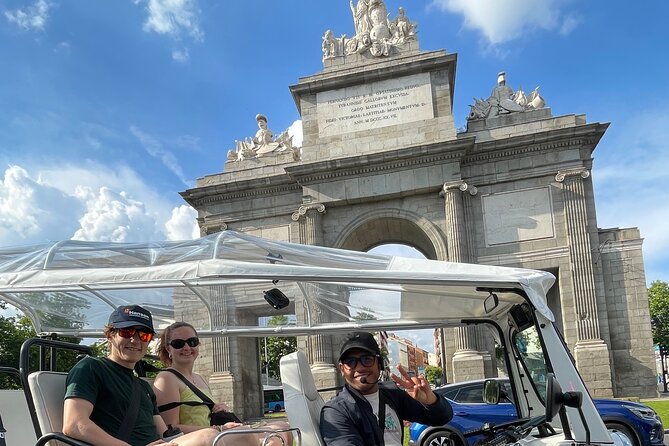
The Puerta de Toledo then shifts the mood from church history to city defenses and royal politics. This gate was one of Madrid’s entrances. The current structure dates from the first third of the 19th century and was designed by architect Antonio Aguado.
It was built as a triumphal arch honoring Ferdinand VII and commemorating Spanish independence after the French occupation. From the tuk-tuk, you get a quick view of the arch in its traffic circle. This is a photo stop rather than an extended visit, so your guide’s explanation matters.
Neptune, Atocha, and Madrid’s art quarter
The Neptune Fountain is one of the city’s grand neoclassical monuments. It was proposed in 1777, built between 1782 and 1786, and first placed along the Carrera de San Jerónimo facing the Cibeles Fountain. It moved to its present square in 1898.
Seeing Neptune and Cibeles on the same route helps you understand Madrid’s 18th-century plan to beautify the capital with classical monuments. The fountains were part of a larger program connected with King Carlos III, the Prado area, the Botanical Garden, and scientific institutions.
Atocha Station brings the route into the city’s working present. It is Spain’s busiest railway station by passenger traffic and began as a simple stop in 1851 before expanding into the Midi Station in 1892.
The station is more than a transport point. It marks the meeting of Madrid’s historic center, major museums, rail connections, and broad avenues. You may want to return here on your own if you are using the train or exploring the nearby museum district.
The Reina Sofía Museum follows. Housed partly in Madrid’s former General Hospital, it focuses on 20th-century and contemporary art. The original neoclassical building was designed by José de Hermosilla and continued by Francesco Sabatini. A newer building by Jean Nouvel expanded the museum in 2005.
If modern art interests you, note this location for a separate visit. The tuk-tuk stop only gives you an exterior orientation and a short account of the museum. It is not enough time for the collection.
A different sort of day out around Madrid:
- Madrid: Tour Bernabéu Entry Ticket
★ 4.5 · 21,573 reviews - Madrid: Prado Museum Entry Ticket
★ 4.6 · 17,509 reviews - Madrid: “Emociones” Live Flamenco Performance
★ 4.8 · 12,866 reviews - Madrid: Panoramic Route City Tour
★ 4.1 · 12,259 reviews
Retiro’s royal remains
The old monastery of San Jerónimo el Real, usually called Los Jerónimos, is one of the route’s more atmospheric stops. The monastery was once connected with the Royal Room and later with the Buen Retiro Palace under Philip IV.
Only two buildings from the old Buen Retiro Palace survive. One is the Casón del Buen Retiro, built by Alonso Carbonel in 1637 as a ballroom for the court of Philip IV. It later became part of the Prado complex and once held 19th-century paintings and Picasso’s Guernica.
Guernica moved to the Reina Sofía in 1992. The Casón reopened in 2009 as a study center after major work, while the 19th-century collection moved back to the Prado’s main building. That detail is useful if you are trying to work out which museum holds what.
The Salón de Reinos, or Hall of Realms, was another major surviving part of the old palace. Its name refers to the painted coats of arms of the 24 kingdoms that formed the Hispanic Monarchy during the reign of Philip IV.
For many years, the building housed the Army Museum, which explains why you may hear it called the Army Museum. Its earlier role as the ceremonial heart of Buen Retiro is the more interesting detail for this route.
These stops are close to the Prado and Retiro areas, making the tour especially helpful on your first morning. You can mark the places where you want to return for more time, rather than trying to visit every one during the tuk-tuk ride.
The Prado, Puerta de Alcalá, and Salamanca
The Prado Museum is one of Madrid’s essential stops, but this tour only allows about five minutes in the area and does not include a museum visit. Treat the stop as a preview.
The Prado is especially strong in Spanish and European painting from the 15th through the 19th centuries. Its major collections include Velázquez, El Greco, Goya, Titian, Rubens, and Bosch. Goya has the largest representation among the museum’s artists, while Velázquez and Bosch are among the major reasons many people schedule a full visit.
The practical benefit here is location. Your guide can show you how the Prado fits into the wider museum district, then you can return later with an admission ticket and several hours to spare.
The Puerta de Alcalá is another former royal gateway. It sits in the center of Plaza de la Independencia, near several entrances to Retiro Park. The monument is easy to recognize and makes a strong photograph, especially when viewed with the surrounding avenues and open space.
The route then reaches the Salamanca district, one of Madrid’s most polished commercial areas. It was developed in part during the 19th century by José de Salamanca y Mayol, the Marquis of Salamanca.
You receive about 20 minutes here, the longest named stop on the route. That makes sense. Salamanca is not just a monument to photograph. It is a district of streets, shops, restaurants, and high-end retail around Serrano, Claudio Coello, and Ortega y Gasset.
The tour does not include shopping, but the stop gives you a quick feel for Madrid’s wealthier side. If you want luxury brands, window-shopping, or a calmer street walk away from the densest historic center, this is the place to return.
Columbus, the National Library, and Cibeles
Plaza de Colón links several major streets, including Goya, Génova, Paseo de la Castellana, and Paseo de Recoletos. The square takes its name from Christopher Columbus and includes a neo-Gothic monument erected between 1881 and 1885.
The National Library of Spain is nearby. It preserves Spain’s bibliographic and documentary heritage, with books, magazines, maps, engravings, drawings, music, and pamphlets dating from the early 18th century onward.
The tuk-tuk gives you the useful outside view: where the library is, how it relates to the square, and why this corner matters. You will need a separate visit for the interior or collections.
Cibeles is one of Madrid’s signature images. The fountain shows the goddess Cybele and sits in the center of the square that carries her name. It was part of Carlos III’s 18th-century plan to reshape and beautify the city.
Look across the square toward the Bank of Spain. The bank’s main headquarters was built between 1884 and 1891 at the junction of Calle Alcalá and Paseo del Prado. Together, Cibeles, the bank, and the surrounding avenues create one of Madrid’s most recognizable city views.
The fountain became part of the city’s popular social life and helped give the wider Prado area the name Salón del Prado. Your guide may connect the fountain, museums, avenues, and civic buildings into one clear story. That connection is more valuable than a string of isolated facts.
Las Ventas and Gran Vía
Las Ventas is Madrid’s largest bullring, with room for 23,798 people. Its ring measures 61.5 meters across, making it one of the major bullfighting arenas in the world.
The tuk-tuk stop is best for a look at the building and a short explanation. It does not include admission, a bullfight, or a full arena visit. If you are interested in the subject, use this stop to decide if you want to come back.
The final major sight is Gran Vía, Madrid’s best-known commercial and entertainment street. It runs from Calle de Alcalá to Plaza de España and has been a major city route since its construction in the early 20th century.
The stretch from Plaza de Callao toward Plaza de España is often linked with musical theater, while the section around the San Luis area and Callao has many international fashion chains. Some older cinemas have closed or changed use, but the street remains one of the clearest places to see Madrid’s modern side.
The tour returns to the starting point at C. de Vergara, 1. That makes planning easy. You can continue on foot toward the palace, Plaza Mayor, or other central sights after the ride.
What the $131.54 group price really buys
The listed price is $131.54 for a group of up to four people, not per person. Four people pay about $33 each, which is fair for a private 90-minute ride with a guide and driver.
For two people, the cost is about $66 each. For one person, it becomes expensive compared with a public walking route or regular city transport. The private format is the key value, so this tour works best when you fill the tuk-tuk.
Bottled water is included. Tips are not, and the activity ends back at the meeting point. Since admission tickets are not included, budget separately if you plan to enter the Royal Palace, Prado, Reina Sofía, or another site after the ride.
The tour is available in English. Most people can participate, and service animals are allowed. Since the vehicle is small, ask yourself how comfortable your group will be sitting close together for 90 minutes.
Reliability, timing, and how to protect your morning
The main weakness is not the route. It is the possibility of a missed pickup or confused meeting arrangement. Some bookings have involved drivers who did not arrive, unanswered calls, or a pickup location that did not match what had been agreed.
After booking, check the exact start point, time, and operator contact details. The tour is scheduled for 9:00 a.m., and the meeting point is C. de Vergara, 1. Arrive early and keep the operator’s contact option available in the booking app.
There has also been confusion when a requested German-speaking guide was replaced by an English and Spanish-speaking guide. English is the stated language, so make that your expectation unless the operator confirms another language directly.
Bad weather can cancel the ride. In that case, you are offered another date or a full refund. You can also cancel for a full refund up to 24 hours before the start time, but cancellations inside that window are not refunded.
Who will enjoy this Madrid tuk-tuk ride?
I would choose this tour for a first morning in Madrid, especially if you want a map in your head before committing to museums and long walks. It is also useful for a family group, a small party of friends, or anyone who wants one private vehicle rather than a large coach.
It suits you if you like short explanations, exterior views, and plenty of city scenery. It is less suitable if you want long time inside the Prado, a guided palace visit, detailed art discussion, or a slow walking tour of each neighborhood.
The strongest guides add local value. Javier has been praised for explaining Madrid and Spain clearly, while Juan has been noted for strong English and an entertaining approach. Jimena has been described as patient and warm, and José and Javier have received praise for their courtesy, energy, and restaurant advice.
Guide quality can vary, and the tour is only as good as the person behind the wheel. Still, the format gives a good guide room to tailor the short stops to your interests.
Should you book this tour?
Book it if you are staying in central Madrid, can fill most of the four seats, and want to see a wide spread of landmarks before choosing where to spend more time. The mix of palace, cathedral, museums, fountains, Salamanca, Las Ventas, and Gran Vía is unusually broad for 90 minutes.
Skip it if your priority is interior access or careful art and architecture study. You should also allow time to confirm the pickup, since missed departures have caused real frustration.
For most first-time visitors, I see this as a city orientation ride, not a complete sightseeing day. Use it to choose your next stops, then return on foot to the Prado, Royal Palace, Retiro, or Reina Sofía with the time those places deserve.
FAQ
Where does the tour start?
The tour starts at C. de Vergara, 1, Centro, 28013 Madrid, Spain.
What time does the tour begin?
The scheduled start time is 9:00 a.m.
How long is the electric tuk-tuk tour?
The experience lasts approximately 1 hour and 30 minutes.
How many people can join one booking?
The private tuk-tuk accommodates a group of up to four people.
Is the tour offered in English?
Yes. English is the offered language, although the assigned guide may vary.
Are entrance tickets included?
No. The experience mainly provides exterior stops, photographs, and brief historical information. Admission is not included for attractions where a ticket is required.
What does the price include?
The price includes the guide and driver, the private tuk-tuk experience, and bottled water. Tips are not included.
Can I cancel for a refund?
Yes. You can cancel at least 24 hours before the start time for a full refund. Cancellations made less than 24 hours before the start time are not refunded.
Just added around Madrid
- Visit the National Archaeological Museum in Madrid★ 4.4 · 6 reviews
- From Madrid: Parque Warner Beach Water Park & Transport★ 3.9 · 14 reviews
- Madrid Wine Tasting, Flamenco Class and Pub Crawl★ 4.5 · 6 reviews
- Virtual Reality Experience Fun And Tickets & Imageen★ 5.0 · 12 reviews
- Visit to the Prado Museum★ 4.9 · 6 reviews
- Prado Museum VIP tour with an art Expert, tickets included★ 5.0 · 11 reviews
- Tuk Tuk Tour with Wine Test in Madrid★ 3.8 · 6 reviews
- Tuktuk historical tour of Madrid 1 Hr in a fun and original way★ 3.7 · 3 reviews
Madrid Tuk Tuk Tours, compared.
Madrid Welcome Tour with Local Guide in Eco Tuk Tuk Private
Read our review →
Madrid Historical Tour with Local Guide in Eco Tuk Tuk Private
Read our review →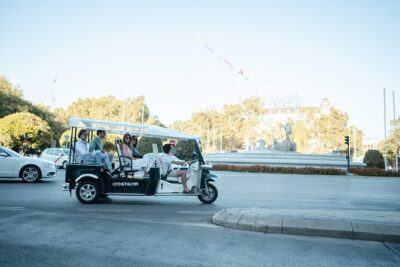
Madrid Express Tour with Local Guide in Eco Tuk Tuk Private
Read our review →
Madrid Expert Tour with Local Guide in Eco Tuk Tuk Private
Read our review →
Madrid Expert Plus Tour with Local Guide in Eco Tuk Tuk Private
Read our review →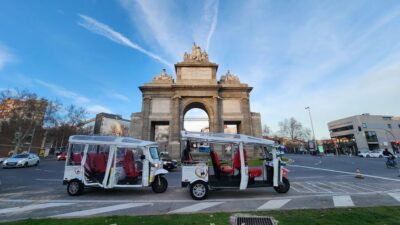
Browse the lists this tour appears in