
Reviewed · MADRID TUK TUK TOURS
Madrid Expert Plus Tour with Local Guide in Eco Tuk Tuk Private
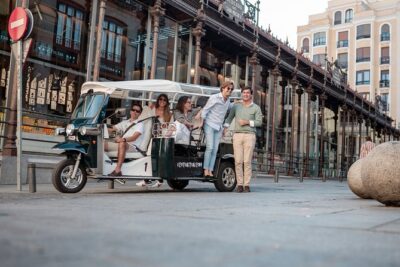
Madrid’s grand avenues, old lanes, royal buildings, and football landmarks are spread across a surprisingly large area. This private electric tuk-tuk tour gives you a quick, comfortable look at the city without committing to a long walking route. I especially like the small private vehicle, limited to four passengers, and the chance to hear local stories from guides such as Christian, Lucia, Juan, Laura, and Carlos. The planned route also covers far more ground than a typical old-town stroll.
The main drawback is that this is primarily a panoramic tour, not a long series of site visits. You’ll stop for selected photographs, but you cannot freely change the route or add extra stops. I also would not arrive late: a delay of more than 15 minutes can shorten or cancel the tour without a refund.
Key points to know before booking
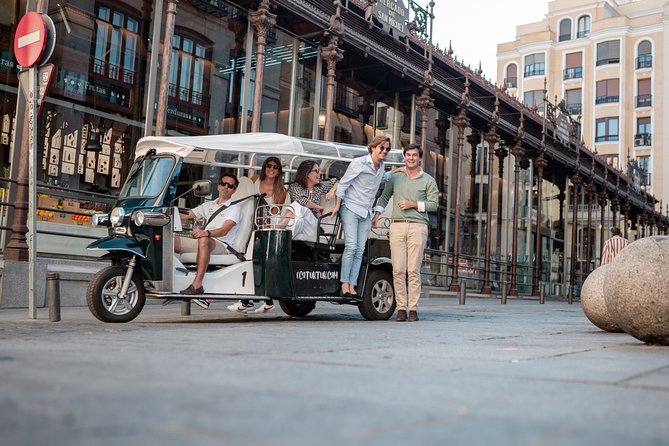
- Private electric tuk-tuk: Your group rides alone, with a maximum of four passengers per vehicle.
- A broad Madrid route: Expect the Royal Palace, Prado area, Puerta de Alcalá, Salamanca, Bernabéu, Cibeles, and Templo de Debod.
- Best for a first look: The tour helps you understand Madrid’s layout before choosing where to return on foot.
- Planned photo stops: Stops are selected in advance, so this is not a fully custom sightseeing ride.
- Weather protection included: Blankets and protective layers are supplied for cold, rain, and wind.
- Two to four hours: A two-hour ride is brisk; three hours is a useful middle choice; four hours gives you more time around the sights.
A fast, friendly introduction to Madrid
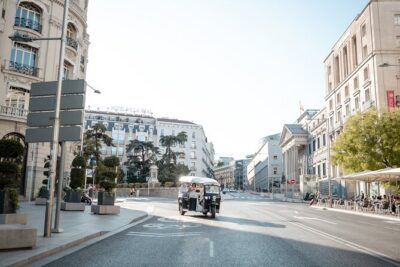
I see this tour as a moving orientation session. You sit above the traffic in a covered electric tuk-tuk while your guide explains the buildings and neighborhoods passing by. The vehicle can reach central streets that a large sightseeing bus cannot, yet it covers enough distance to connect Madrid’s old center with Salamanca, the Castellana, and the Bernabéu area.
The strongest part is the guide. The names attached to particularly well-received tours include Christian, Lucia, Juan, Enrique, Laura, Lluis, Julian, Camilo, Clara, David, Ivan, Alexander, and Carlos. You can expect a personal style rather than a recorded commentary, with explanations of Madrid’s past, local customs, food, football, and practical ideas for eating and shopping.
The electric vehicle matters in central Madrid. It is quiet, compact, and less cumbersome on narrow streets than a bus. You also avoid spending the first day of your trip figuring out how the city’s many districts fit together.
There is a tradeoff. The tuk-tuk is open-sided, so the view is excellent in good weather but less comfortable in cold rain or wind. Plastic side curtains can protect you, but they may make photographs and sightseeing less clear. Blankets are supplied in winter, although one customer found that blankets were not provided on a particular ride. If you feel the cold easily, dress warmly anyway.
More Madrid Tuk Tuk Tours:
- Madrid Welcome Tour with Local Guide in Eco Tuk Tuk Private
★ 5.0 · 2,936 reviews - Madrid: Private City Tour by Eco Tuk Tuk
★ 4.9 · 2,876 reviews - Madrid Historical Tour with Local Guide in Eco Tuk Tuk Private
★ 5.0 · 876 reviews
Meeting the tuk-tuk beside the Royal Palace
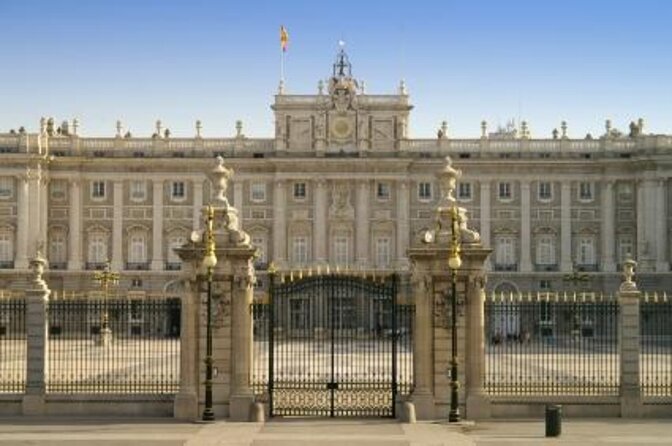
The starting point is at Calle de Bailén 4, beside the Royal Palace, at the underground bus station near the Plaza de Oriente. The address can be confusing because the number may not appear clearly on the street. Search for Calle Bailén 4 or Puerta del Príncipe, then look for the stairs opposite the Prince’s Gate and the Eco Tuk Tuk signs.
If stairs are difficult, contact the operator by phone, WhatsApp, or email for elevator access. The vehicle is suitable for older passengers, and the driver can help you get aboard.
Arrive early. The rules are strict: if you are more than 15 minutes late, the activity may be cancelled without a refund. A delayed flight or a slow airport transfer is a poor match for this booking, so schedule it after you have settled into Madrid rather than immediately after landing.
The tour ends back at the starting point. Hotel pickup is not included, and the company cannot provide transfers outside the route.
Food, rail travel, and the first city landmarks
The route can include a covered market dating from about 1916, with local food, delicatessen counters, and events in an elegant setting. This is a useful reminder that Madrid is not only palaces and museums. If your guide pauses nearby, ask for suggestions on what to taste later, since the market is better treated as a quick orientation point than a full food tour.
Atocha Station gives you a look at Madrid’s main rail gateway. It is the country’s busiest station and a major European transport hub, near Plaza del Emperador Carlos V. The station is also a practical reference point if you plan to take high-speed trains to places such as Toledo or Córdoba, though those trips are not part of this activity.
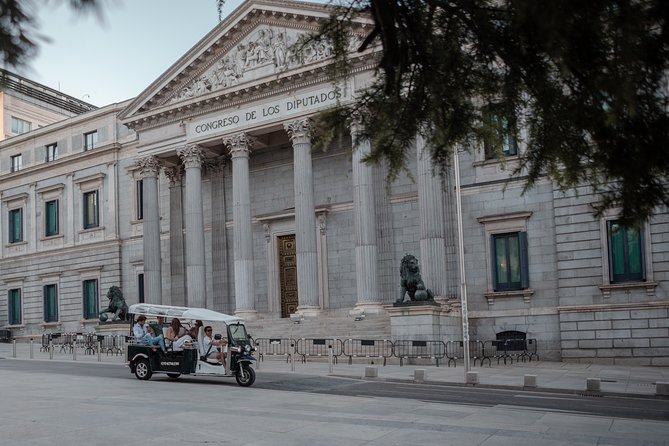
The Palace of the Spanish Courts follows the grand civic style of central Madrid. Its neoclassical facade has six Corinthian columns, a triangular pediment, and the famous bronze lions cast from cannon metal captured during the war in Africa. The interior rooms, including the Session Room and library, are not part of the tuk-tuk visit, so you will mainly hear the story and see the exterior.
At Plaza de Cánovas del Castillo, the Fountain of Neptune gives the route another piece of eighteenth-century Madrid. Built between 1782 and 1786, the neoclassical fountain shows Neptune in his chariot. It is a good example of how Madrid uses broad roundabouts and monumental fountains to link major avenues.
The Prado area, from paintings to royal ceremony
The Prado Museum is the artistic heavyweight on the route. It holds major collections of Velázquez, El Greco, Goya, Titian, Rubens, Bosch, Murillo, Ribera, Zurbarán, Raphael, and other European masters from the sixteenth through nineteenth centuries.
You will not enter the museum during this tuk-tuk experience. That limitation matters. The guide can explain why the Prado is so important and point out its location, but you need a separate timed ticket and several hours if you want to see the paintings properly. I recommend using this tour to decide how the museum fits into the rest of your visit, not as a substitute for going inside.
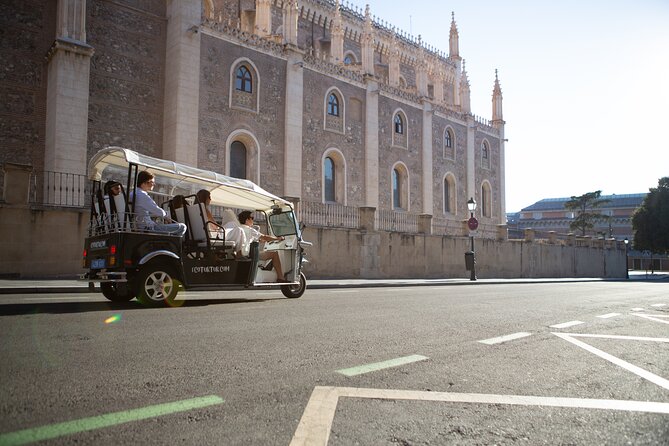
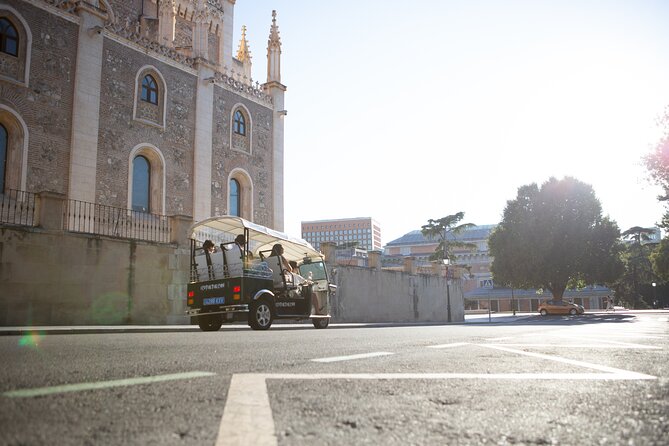
Nearby, the Church of San Jerónimo el Real is known locally as Los Jerónimos. It is a late Gothic church with Renaissance touches, tied to Spain’s royal family. The Catholic Monarchs ordered its construction, and it later became a place of royal retreat and ceremony. Alfonso XIII’s wedding took place here, and the grand staircase leading to the entrance was built for that occasion in 1906.
This area rewards careful listening. The buildings are close together, but their stories cover art, monarchy, religion, and public life. A guide can connect those subjects far better than a quick drive past them alone.
A different sort of day out around Madrid:
- Madrid: Tour Bernabéu Entry Ticket
★ 4.5 · 21,573 reviews - Madrid: Prado Museum Entry Ticket
★ 4.6 · 17,509 reviews - Madrid: “Emociones” Live Flamenco Performance
★ 4.8 · 12,866 reviews - Madrid: Panoramic Route City Tour
★ 4.1 · 12,259 reviews
Puerta de Alcalá and the Salamanca district
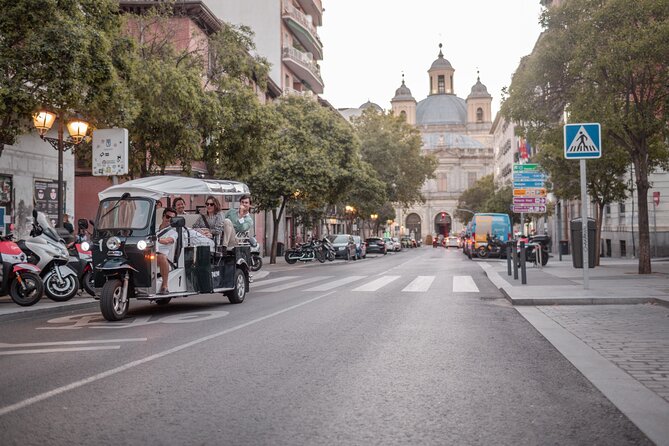
Puerta de Alcalá is one of Madrid’s most recognizable monuments. Built for Charles III and opened in 1778, it was designed by Francesco Sabatini as a granite triumphal arch. Its five openings are unusual, and the two sides carry different decoration. The side facing visitors entering Madrid is more ornate, with the royal coat of arms.
The gate marks the old road toward Alcalá de Henares. It also provides one of the clearest examples of Madrid’s grand urban design: wide streets, formal gardens, and monuments meant to impress people arriving in the capital.
From there, the tuk-tuk enters the Salamanca district and follows streets including Velázquez, Ortega y Gasset, and Serrano. This is an affluent area known for polished architecture, shopping, and broad avenues. I like this part because it shows a Madrid very different from the narrow lanes around Plaza Mayor.
The tour then continues along the Paseo de la Castellana toward Santiago Bernabéu Stadium. The stadium was inaugurated in 1947 and now holds 81,044 people. It is a major stop for football fans, but even non-supporters can appreciate its scale and the role Real Madrid plays in the city’s identity.
Do not assume this is a stadium visit. The tour passes the exterior, and the experience does not include admission to the stadium or its museum. If you want the full football experience, book that separately and allow extra time.
Columbus, the National Library, and Cibeles
The Columbus monument presides over its busy central square. The white marble statue and carved pedestal reach 17 meters and were completed in 1885 by Jerónimo Suñol. The nearby Gardens of Discovery contain sculptures linked to the discovery of America, while the Fernán Gómez Cultural Center sits below the square.
The monument offers a chance to discuss Spain’s role in overseas exploration, along with the complicated legacy attached to that history. You will see the sculpture from the vehicle or during a planned stop, rather than spend time inside the cultural center.
The National Library of Spain is another impressive exterior. Its holdings include about thirty million books, magazines, maps, prints, drawings, music scores, and pamphlets produced in Spain since the early eighteenth century. The library’s museum and exhibition rooms share parts of this collection, but they are not included in the tuk-tuk tour.
Cibeles is one of Madrid’s essential photo stops. The fountain shows the Roman goddess Cybele in a chariot drawn by two lions. Around it sit the Buenavista Palace, Linares Palace, Communications Palace, now Madrid’s city hall, and the Bank of Spain.
Football fans will recognize Cibeles as the traditional celebration point for Real Madrid titles and Spanish national team successes. Even if football is not your interest, the setting explains Madrid’s fondness for ceremonial public spaces.
The Bank of Spain adds another layer of grand architecture. Its elaborate design was created to give the national bank a home suited to its role as the sole issuer of Spanish currency. The interior is not open for ordinary sightseeing, so the value here is the exterior view and the guide’s explanation.
Plaza de Santa Ana and the old center
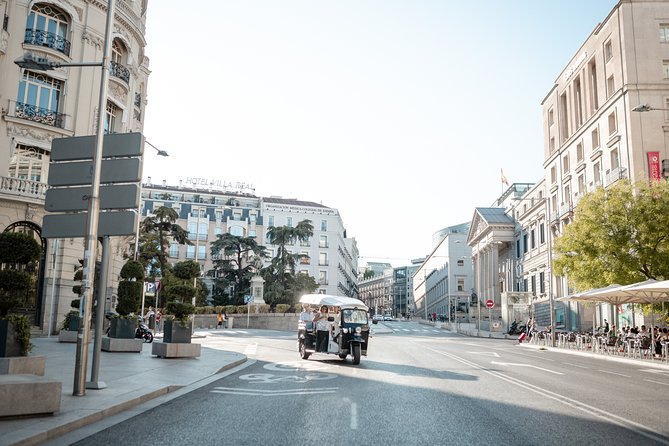
Plaza de Santa Ana sits in the Cortes neighborhood and dates from 1810. It has changed through several urban redesigns, but it remains one of the more pleasant open spaces in central Madrid.
The square works well as a bridge between the grand avenues and the older center. You may want to return here later for a drink or meal, but the tuk-tuk stop is not designed as a long break. The exact time spent at each location depends on the tour length, traffic, and the day’s route.
The Royal Basilica of San Francisco el Grande is another major religious building in the historic center. Officially called the Basilica of Our Lady of the Angels, it is in the Palacio neighborhood. Its scale and position help explain the religious and royal importance of this part of Madrid.
The Almudena Cathedral is Madrid’s principal cathedral and was consecrated by Pope John Paul II in 1993. Its museum contains objects connected with the history of the Madrid diocese, including mosaics and episcopal shields. Again, the tuk-tuk gives you an exterior introduction, not a museum visit.
The Royal Palace, Campo del Moro, and Templo de Debod
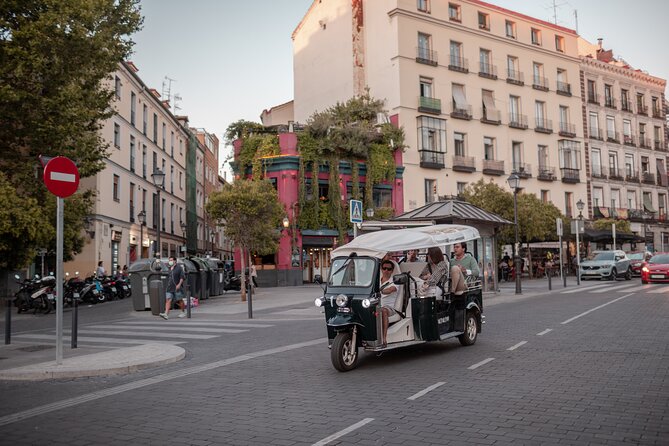
The Royal Palace is the grandest stop on the route. Construction began in 1738 after the earlier Habsburg palace burned on Christmas Eve in 1734. The new palace took seventeen years to build, and Charles III moved in as his regular residence in 1764.
Today, Spain’s kings use the palace for receptions, ceremonies, and official events, while living at Zarzuela Palace. The building is also called the Palacio de Oriente. Its position beside the Campo del Moro and Sabatini Gardens gives you a sense of how the royal complex shaped the city around it.
Campo del Moro covers about twenty hectares between the western facade of the palace and the Paseo de la Virgen del Puerto. The gardens were declared a site of historic and artistic interest in 1931. You may see the grounds from the route, but garden access is not included as a separate guided visit.
The final stop, Templo de Debod, is one of Madrid’s most unusual sights. This ancient Egyptian temple now sits on a hill west of Plaza de España, near the Paseo del Pintor Rosales. It was given to Spain and reassembled in Madrid, where its setting provides open views across the city.
The temple stop lasts about 15 minutes and admission is free. This is one of the few points where you get a clear pause to take photographs. Sunset can be especially appealing, but evening traffic and colder temperatures may affect the route.
Choosing two, three, or four hours
The two-hour option is best if you want a quick first look, have limited time, or prefer not to sit in the vehicle too long. It moves quickly through the major districts and gives you enough information to plan the rest of your stay.
Three hours is the most balanced choice. You get a broader route, more time for the guide’s stories, and a better chance to pause at selected photo points. Several people who chose three hours found it a comfortable way to see the city without turning the day into a walking marathon.
Four hours suits you if walking is difficult, if you want the widest overview, or if this is your main sightseeing activity for the day. One practical caution: four hours can feel long if you have already spent days on walking tours or if the weather is poor. A customer arriving after an overnight flight also found the full length tiring.
The route cannot be altered on the spot, and photo stops are arranged in advance. Your guide may adapt around road closures, demonstrations, traffic, or crowded streets, but you should not book this expecting a fully custom private car service.
Price, group size, and comfort
At about $28.67 per person, the tour offers good value when four people share one tuk-tuk. You get a private vehicle and guide rather than joining a large bus, and the route covers many parts of Madrid in one sitting.
For one or two passengers, the value is less striking, though the privacy and convenience may still justify it. The legal limit is four passengers per tuk-tuk, and larger parties need more than one vehicle. Group discounts may be available.
Blankets and protective layers are provided for rain and wind, and the tours operate in ordinary rain or heat unless conditions become extreme. Wear warm clothing in winter. Pets are not allowed, and babies are not accepted. The minimum age is two years, with a minimum passenger weight of 9 kilograms.
Free cancellation is available if you cancel at least 24 hours before the scheduled start. Changes made inside that window are not accepted, so keep your plans firm.
Who should book this Madrid tuk-tuk tour?
Book it if you are visiting Madrid for the first time, have only a few days, or want to understand the city before exploring it on foot. It is also useful for older passengers and anyone who wants a break from long walks while still seeing districts beyond the historic center.
Families can appreciate the private setting, though young children must meet the stated age and weight rules. Football fans get the Bernabéu and Cibeles, art lovers get the Prado area, and history fans get royal, civic, religious, and Egyptian landmarks in one ride.
Skip it if your priority is entering museums, touring the Royal Palace interiors, or stopping wherever you please. For that kind of trip, use the tour as an introduction, then plan separate visits with proper admission time.
Should you book it?
I would book this for the first morning or afternoon of a Madrid stay, provided I could arrive on time and dress for the weather. The two-hour tour is efficient, while three hours gives you the best balance of coverage and comfort.
The big reasons to choose it are the private electric vehicle, the wide route, and the personal guide commentary. The key limitation is just as clear: you see many places from outside and stop only at prearranged points. If that suits your plans, this is an enjoyable and practical way to get your Madrid bearings fast.
FAQ
Where does the Madrid tuk-tuk tour begin?
It begins at C. de Bailén 4 beside the Royal Palace, near the underground bus station at Plaza de Oriente. Search for Calle Bailén 4 or Puerta del Príncipe and follow the Eco Tuk Tuk signs.
How long does the tour last?
The experience lasts approximately two to four hours. A two-hour ride is the quickest overview, while three or four hours allow more time for the route and planned stops.
How many people can ride in one tuk-tuk?
The legal maximum is four passengers per tuk-tuk. Larger groups may require more than one vehicle.
Is hotel pickup included?
No. Hotel pickup and drop-off are not included, and transfers outside the tour route are not provided.
Does the tour operate in bad weather?
Tours operate in rain and heat and are cancelled only under extreme conditions. Blankets and protective layers are supplied for cold, rain, and wind, but you should still dress appropriately.
Can I cancel for a full refund?
Yes, if you cancel at least 24 hours before the experience start time. Cancellations or changes made less than 24 hours in advance are not accepted and are not refunded.
Just added around Madrid
- Visit the National Archaeological Museum in Madrid★ 4.4 · 6 reviews
- From Madrid: Parque Warner Beach Water Park & Transport★ 3.9 · 14 reviews
- Madrid Wine Tasting, Flamenco Class and Pub Crawl★ 4.5 · 6 reviews
- Virtual Reality Experience Fun And Tickets & Imageen★ 5.0 · 12 reviews
- Visit to the Prado Museum★ 4.9 · 6 reviews
- Tuk Tuk Tour with Wine Test in Madrid★ 3.8 · 6 reviews
- Tuktuk historical tour of Madrid 1 Hr in a fun and original way★ 3.7 · 3 reviews
- Prado Museum VIP tour with an art Expert, tickets included★ 5.0 · 11 reviews
Madrid Tuk Tuk Tours, compared.
Madrid Welcome Tour with Local Guide in Eco Tuk Tuk Private
Read our review →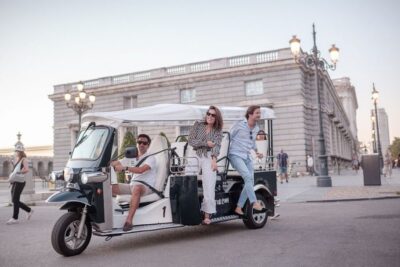
Madrid Historical Tour with Local Guide in Eco Tuk Tuk Private
Read our review →
Madrid Express Tour with Local Guide in Eco Tuk Tuk Private
Read our review →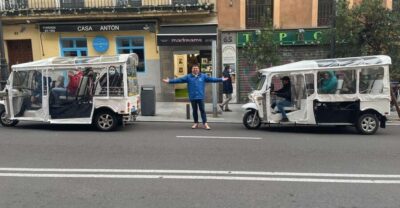
Madrid Expert Tour with Local Guide in Eco Tuk Tuk Private
Read our review →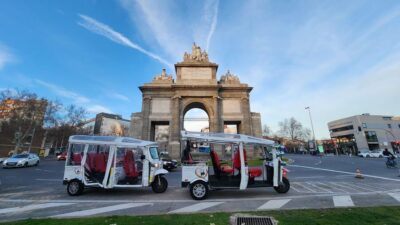
Christmas Lights Tour of Madrid in Eco Tuk Tuk Private
Read our review →Browse the lists this tour appears in