
Reviewed · MUSEUMS
Madrid: Guided Tour of the Royal Collections Gallery
The most unusual part of this Madrid museum visit is the way royal power appears through objects rather than palace rooms alone. You move from the Trastámara rulers to the Habsburgs and Bourbons, then finish below ground beside remains of Islamic Mayrit, the settlement that gave Madrid its name.
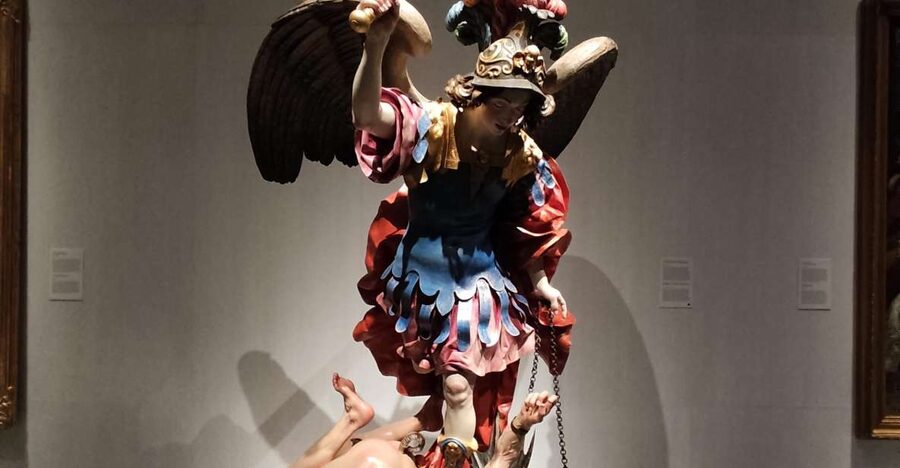
I like the clear chronological route, which helps you connect portraits, furniture, arms, paintings, and ceremonial objects to the rulers who owned them. I also like the chance to see Velázquez’s The White Horse, La Roldana’s Archangel Saint Michael, and the armor linked to Charles I in one focused visit.
The main consideration is time. Two hours gives you a useful introduction, but the collection is large and the guide must keep moving. If you want to study every painting or read every label, you may prefer to return on your own afterward.
Key points to know before you go
- The collection opened in June 2023, making this one of Madrid’s newer major museum experiences.
- The route covers three dynastic periods, from the Trastámara rulers through the Habsburgs and Bourbons.
- Velázquez’s The White Horse is one of the tour’s most memorable paintings.
- The basement includes archaeological remains of Islamic Mayrit, adding an older layer to Madrid’s story.
- The tour lasts two hours and includes a live guide in English or Spanish, plus an audio guide in both languages.
- You meet at Calle Mayor 43, twenty minutes before the start, and use a separate entrance to skip the regular line.
Why the Royal Collections Gallery deserves two hours
Madrid has famous art museums, but the Royal Collections Gallery offers a different kind of visit. It is not mainly about one painter, one school, or one century. Instead, it shows how Spain’s monarchs collected, commissioned, used, and displayed objects over several dynasties.
That makes the museum especially useful if you want context for the Royal Palace and for Spain’s long royal tradition. Paintings matter here, but so do armor, clocks, furniture, carriages, religious sculpture, and wall hangings. The objects work together to show how a court operated and how rulers wanted to be seen.
The gallery was inaugurated in June 2023, so it feels like a newer addition to Madrid’s museum circuit. The collection itself is old, of course. Many objects were preserved by the Crown over centuries, but the setting gives them a modern home and a carefully ordered route.
I would choose the guided visit if this is your first time with Spanish royal art. Without some explanation, a portrait of one monarch can look much like another. A guide can point out changes in dress, ceremony, military display, religious feeling, and court taste that are easy to miss when you walk alone.
More Museums in Madrid:
- Madrid: Prado Museum Entry Ticket
★ 4.6 · 17,509 reviews - Madrid: Reina Sofía Museum Entrance Ticket
★ 4.5 · 6,889 reviews - Madrid: Small Group of Prado Museum Tour & Optional Tapas
★ 4.6 · 2,437 reviews
Meeting at Calle Mayor 43
The tour begins at the Fun And Tickets office at Calle Mayor, 43. You are asked to arrive 20 minutes before the scheduled start, which is sensible. The group first gathers at the office, then goes to the gallery together.
This meeting point is important because the tour does not begin at the museum entrance. Build the extra walk into your plan, and do not cut arrival too close. The activity finishes at the Royal Collections Gallery, not back at the office, so you can continue exploring the area afterward.
The separate entrance is a practical benefit. It does not remove the need to arrive on time, but it can make the start smoother than joining the general admission line. Since group size is not specified, I would not assume a tiny private tour. Think of this as a structured group visit with a guide leading the way.
The live guide speaks English or Spanish. An audio guide is also included in English and Spanish, giving you a second way to follow along. If you sometimes miss details in a group, having both options is useful.
The Trastámara beginning and Queen Isabella
The route starts with the Trastámara period, introducing you to the earlier stage of the royal collection. Queen Isabella I receives particular attention, including her well-known portrait.
This first section gives the visit a necessary starting point. The later Habsburg and Bourbon displays can seem overwhelming without a sense of what came before them. Beginning with the Trastámaras lets you watch the collection grow rather than encountering a pile of unrelated royal objects.
The portrait of Isabella is more than a familiar face on a museum wall. It represents the way monarchy used images to project authority and permanence. A guide can help you read the formal pose, clothing, symbols, and setting as political choices, not just artistic details.
Do not expect the Trastámara section to fill the entire visit. It serves as the opening chapter before the larger displays dedicated to the Habsburgs and Bourbons. If your main interest is Isabella, give yourself a little extra time to look closely before the group moves onward.
The Habsburg rooms: art, armor, and royal display
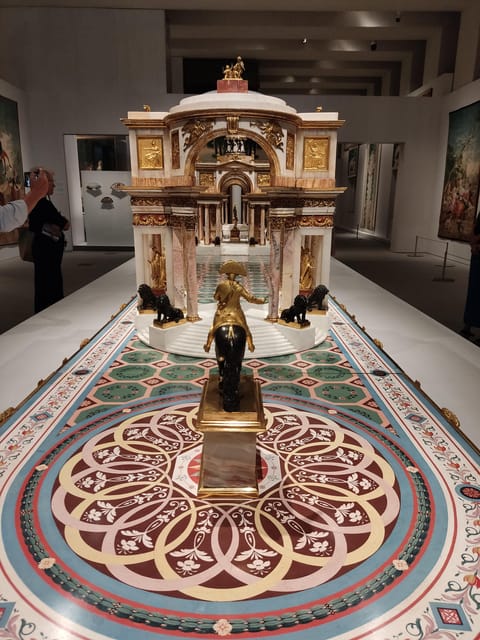
The Habsburg section brings together objects from the reigns of Charles I, Philip II, Philip III, Philip IV, and Charles II. You will see paintings, sculpture, tapestries, and artifacts, giving the room a broad courtly feel rather than a single-art-form focus.
This is where the collection’s range becomes clear. One object may reflect religious devotion, another military authority, and another the luxurious daily life of the court. Taken together, they show how Habsburg rulers presented themselves at home, in church, and on the battlefield.
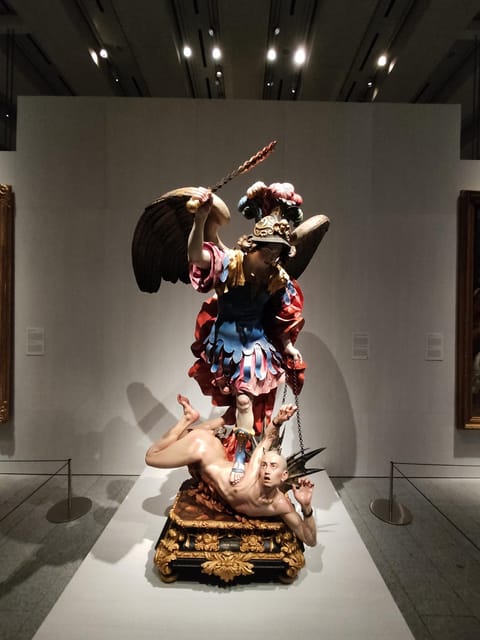
La Roldana’s sculpture of the Archangel Saint Michael triumphing over the devil is one of the key works to watch for. The subject is dramatic by design, and the sculpture links artistic skill with religious imagery and royal patronage. It also offers a change of scale and texture from the painted portraits around it.
Velázquez’s The White Horse is another major stop. The riderless horse gives the painting a strange, memorable quality. It is not a routine equestrian portrait with a monarch mounted in the saddle. The animal’s controlled posture and pale form create a striking image of royal power without showing the ruler directly.
Look closely at how the painting works through restraint. The horse is the subject, yet it can suggest ceremony, command, and prestige. You will get more from the work if you pause for the composition rather than treating it as a quick name on the guide’s list.
The armor associated with Charles I adds a physical connection to the Habsburg era. Armor can be easy to dismiss as decoration, but here it points to the way a ruler’s body was presented in public. It signals rank, military strength, and ceremony all at once.
For many visitors, this section will be the artistic high point. The drawback is that the number of rulers and objects can blur together during a fast explanation. I recommend choosing two or three pieces to remember, such as The White Horse, the Saint Michael sculpture, and Charles I’s armor, instead of trying to retain every royal name.
More Madrid Tours:
- Madrid: Tour Bernabéu Entry Ticket
★ 4.5 · 21,573 reviews - Madrid: “Emociones” Live Flamenco Performance
★ 4.8 · 12,866 reviews - Madrid: Panoramic Route City Tour
★ 4.1 · 12,259 reviews - Madrid: Live Flamenco Show with Food and Drinks Options
★ 4.5 · 9,901 reviews
The Bourbon level and the look of an 18th-century court
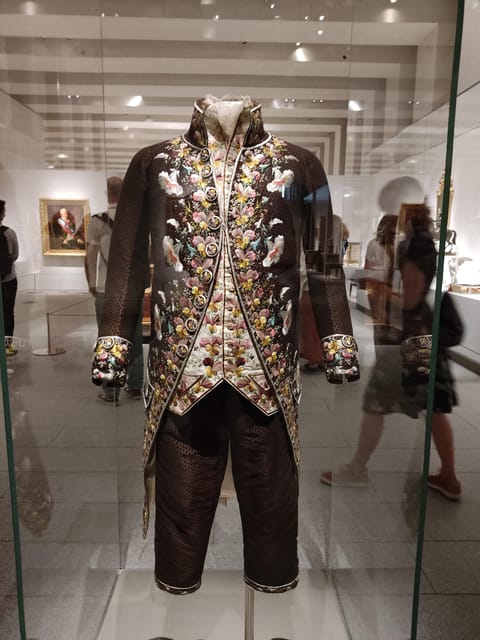
The Bourbon section covers a long list of rulers: Philip V, Louis I, Ferdinand VI, Charles III, Charles IV, Ferdinand VII, Isabel II, Alfonso XII, and Alfonso XIII. The displays include furniture, clocks, tapestries, and paintings, with a strong emphasis on the 18th century.
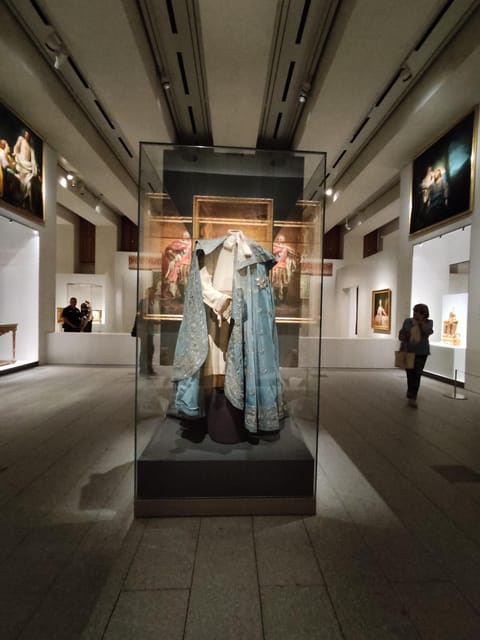
This part shows how court life changed after the Habsburg period. Furniture and clocks may seem less dramatic than a famous painting, but they reveal how rooms were arranged, how time was measured, and how royal status appeared in daily surroundings.
The clocks deserve attention because they combine function with display. In a palace setting, a clock could be a practical object and a sign of taste, technology, and wealth. Furniture works in a similar way. A chair, cabinet, or table can tell you about ceremony, comfort, and the distance between a monarch and everyone else.
You will also encounter paintings and decorative objects that help explain the style of the Bourbon court. The route is not limited to famous masterworks, and that is part of its value. It gives you a broader picture of royal life instead of reducing the period to a handful of celebrated names.
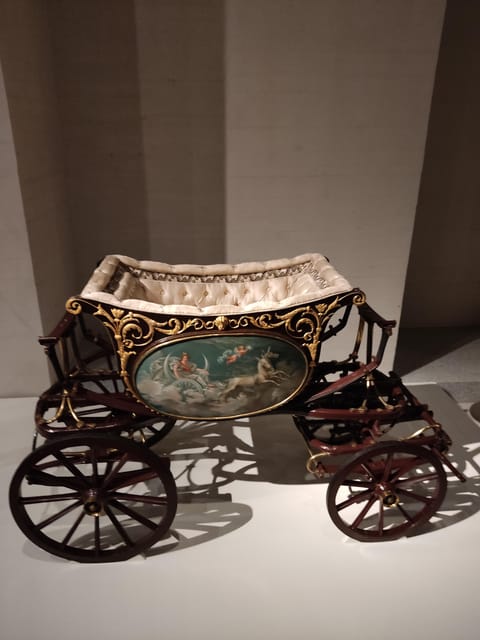
A 19th-century carriage provides a welcome change in scale. It is an object you can understand at once: large, practical, formal, and built to be seen. Its size helps you imagine the public side of monarchy, when movement through the city could itself become a display of rank.
The photographs connected to the Prisoners’ Office are especially unusual. Alfonso XIII established this office within the Royal Palace during the First World War. The images bring a more human and political subject into a collection otherwise filled with luxury and ceremony.
This material also reminds you that royal history is not only about art and decoration. It includes decisions, public roles, and attempts to respond to events beyond the palace. The photographs can become one of the tour’s most affecting stops because they shift the mood from display to real people facing hardship.
Islamic Mayrit beneath the modern gallery
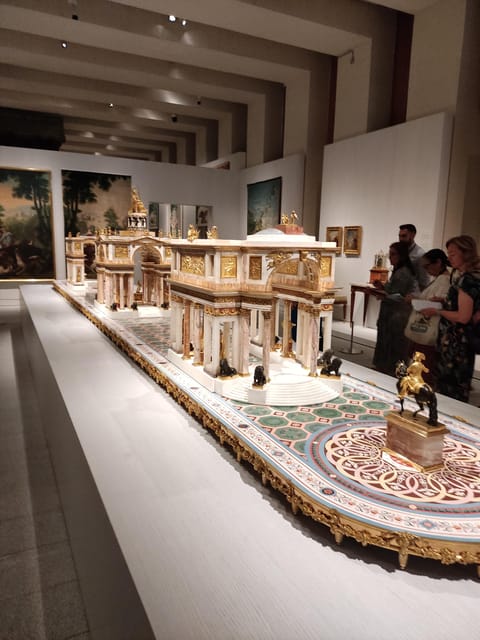
The visit continues to the basement, where archaeological remains of Islamic Mayrit were found during construction of the gallery. This is one of the most valuable parts of the route for anyone interested in Madrid before the Christian kingdoms and royal palace era.
The remains connect the modern city to its Islamic origins. Madrid did not begin as a Bourbon court city. The Mayrit evidence gives you a glimpse of an earlier settlement and reminds you that the capital’s story reaches back far before the royal collections on the upper floors.
Because these remains appear at the end, they also work as a useful change of perspective. You begin with rulers and royal portraits, then finish with the physical traces of an older Madrid. The contrast is strong: above ground, carefully preserved objects from the Crown; below ground, archaeological evidence of an earlier settlement.
The basement stop is included within the two-hour visit, but the information provided does not specify how extensive the remains are or how long the group stays there. Keep your expectations measured. This is an important historical layer, but it is not presented as a separate archaeological museum tour.
How much value do you get for $69?
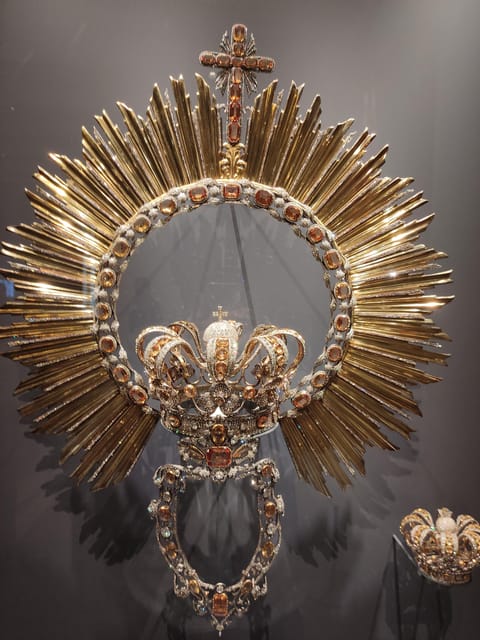
At $69 per person, this is not the cheapest way to spend two hours in Madrid. The value depends on what you want from the visit.
You are paying for admission, a live official guide, a separate entrance to skip the regular line, and an audio guide in English or Spanish. For someone who wants a guided introduction to a large and unfamiliar collection, those elements can justify the price.
The tour also saves you from building your own route through several centuries of royal material. You do not need to decide in advance which dynasty to prioritize or how the objects fit together. That structure has real value, particularly if you have limited time in Madrid.
The price is harder to justify if you already know Spanish royal art well or prefer to move slowly on your own. A two-hour guided route has a fixed rhythm. You may want more time with Velázquez, the La Roldana sculpture, the armor, or the Mayrit remains than the schedule allows.
I see this as a good choice for a first visit, especially when you value explanation more than complete independence. If you book, use the guide to identify the pieces you most want to revisit. You can then return to the gallery on your own if your ticket arrangements allow, though that extra visit is not stated as part of the activity.
Who should book this guided visit?
I would recommend it to first-time visitors to the Royal Collections Gallery, people with a strong interest in Spanish monarchies, and anyone who wants a clear route through a large museum. It also suits visitors who enjoy seeing how paintings, furniture, military objects, and archaeological remains fit into one story.
Families and mixed-interest groups may find the changing displays helpful. The horse, armor, carriage, and underground remains offer variety, so you are not looking at portraits for two straight hours.
Art specialists may want a slower, more focused museum visit instead. The guide-led format is designed to cover the major periods and objects, not to provide a detailed study of every work.
The experience is wheelchair accessible, which makes it practical for visitors who need step-free access. Starting times vary, so check availability before you choose your date.
A few practical ways to enjoy the route
Arrive at Calle Mayor 43 early, not at the gallery. The meeting office is the starting point, and the group leaves from there.
Listen for the guide’s explanation of the dynastic sequence. Remembering Trastámara, Habsburg, and Bourbon as three broad chapters will make the many royal names easier to place.
Choose a few anchor objects. I would pick Isabella’s portrait, The White Horse, the Saint Michael sculpture, Charles I’s armor, the carriage, and the Mayrit remains.
Use the audio guide as support rather than as a second tour running at full volume in your head. The live guide provides the route and context, while the audio option can help if you miss a detail.
Allow extra time in your day for the possibility that you will want to look again at a favorite section. Two hours is enough for an introduction, but not enough for a slow study of the whole collection.
Should you book the Royal Collections Gallery tour?
Book it if you want a guided overview with strong historical structure and you are happy to keep a steady pace. The combination of royal art, armor, furniture, a carriage, wartime photographs, and Islamic Mayrit remains gives the visit more variety than a standard portrait tour.
Skip it if your priority is complete freedom or close study of individual works. At $69, the guide and separate entrance need to matter to you.
For most first-time visitors, I think the organized route earns its place in a Madrid schedule. You leave with a clearer sense of how Spain’s royal collection developed, and you see several memorable objects along the way.
FAQ
Where does the tour begin?
It begins at the Fun And Tickets office at Calle Mayor, 43, in Madrid.
How early should I arrive?
You should arrive at the meeting point 20 minutes before the tour starts.
How long does the guided visit last?
The guided visit lasts two hours.
Which languages are available?
The live tour guide is available in English and Spanish. An audio guide is also included in English and Spanish.
Is admission to the Royal Collections Gallery included?
Yes. The ticket to the Royal Gallery and the official guided visit are included.
Is the experience wheelchair accessible?
Yes, the activity is wheelchair accessible.
Just added around Madrid
- Visit the National Archaeological Museum in Madrid★ 4.4 · 6 reviews
- From Madrid: Parque Warner Beach Water Park & Transport★ 3.9 · 14 reviews
- Madrid Wine Tasting, Flamenco Class and Pub Crawl★ 4.5 · 6 reviews
- Virtual Reality Experience Fun And Tickets & Imageen★ 5.0 · 12 reviews
- Visit to the Prado Museum★ 4.9 · 6 reviews
- Tuk Tuk Tour with Wine Test in Madrid★ 3.8 · 6 reviews
- Tuktuk historical tour of Madrid 1 Hr in a fun and original way★ 3.7 · 3 reviews
- Prado Museum VIP tour with an art Expert, tickets included★ 5.0 · 11 reviews
Museums, compared.

Small Group of Prado Museum Tour & Optional Tapas
Read our review →
Prado Museum Guided Tour with Skip-the-Line Ticket
Read our review →
Prado Museum Small Group Tour with Skip the Line Ticket
Read our review →
Royal Palace & Prado Museum Skip the Line Guided Tour
Read our review →
Browse the lists this tour appears in