

Reviewed · MADRID ESCAPE ROOMS AND GAMES
Madrid: Prison Island Giant Indoor Escape Game Entry Ticket
Prison Island turns the escape-room idea into a full indoor arena. Instead of working through one puzzle in a fixed order, you and your team move among 32 themed cells, choosing challenges that test brains, balance, strength, timing, and teamwork. Your goal is not simply to get out. It is to collect as many points as you can.
I like the freedom to pick your next challenge and the clear scoring system, which gives the game a lively competitive edge. I also like that it suits a mixed group: one person can shine at logic puzzles while another handles a physical or tactical task. The main drawback is that some challenges may not explain themselves at once, so you need patience and good communication rather than expecting constant clues.
Key points
- 32 separate challenge rooms: Move between themed cells rather than following one single escape-room route.
- Three kinds of skill: Expect a blend of mental puzzles, physical tasks, and tactical decisions.
- Up to two hours of play: The time gives you room to try many cells and improve your score.
- A final leaderboard: Check how your team performed once the game ends.
- Good for groups from age 10: Families, friends, and work teams can play together, though the published age guidance for older players should be checked carefully.
- Comfortable clothing matters: You may need to move, think quickly, and tackle active challenges.
Prison Island in Madrid, a different kind of escape game
Traditional escape rooms usually give you one room, one storyline, and one route toward the exit. Prison Island takes a broader approach. You enter a futuristic indoor prison and choose from a bank of separate cells, each with its own task.
That difference matters. If your group gets stuck on a puzzle, you do not have to spend the rest of the session staring at it. You can leave, try another cell, and return later with a fresh plan. This makes the activity less frustrating than a single all-or-nothing escape room, although the freedom can also make your first few minutes feel a little unfocused.
The concept draws inspiration from the television show Fort Boyard, where teams face physical trials and mental tests in a dramatic setting. Here, the action takes place indoors in Madrid, with a high-tech prison theme rather than a historic building or outdoor course.
You are not simply racing toward a door. You are building a score. Every completed task contributes to your team’s result, and the leaderboard gives the session a clear finish. That scoring system is especially useful for groups that enjoy a little friendly rivalry.
More Madrid Escape Rooms and Games:
- Escape game Madrid, chase the killer
★ 4.5 · 37 reviews - Madrid: Retro Escape Room “HEX Game”
★ 5.0 · 5 reviews - Madrid: Scary Escape Room “The Haunted Box”
★ 4.8 · 5 reviews
Getting started at the Spark Island entrance

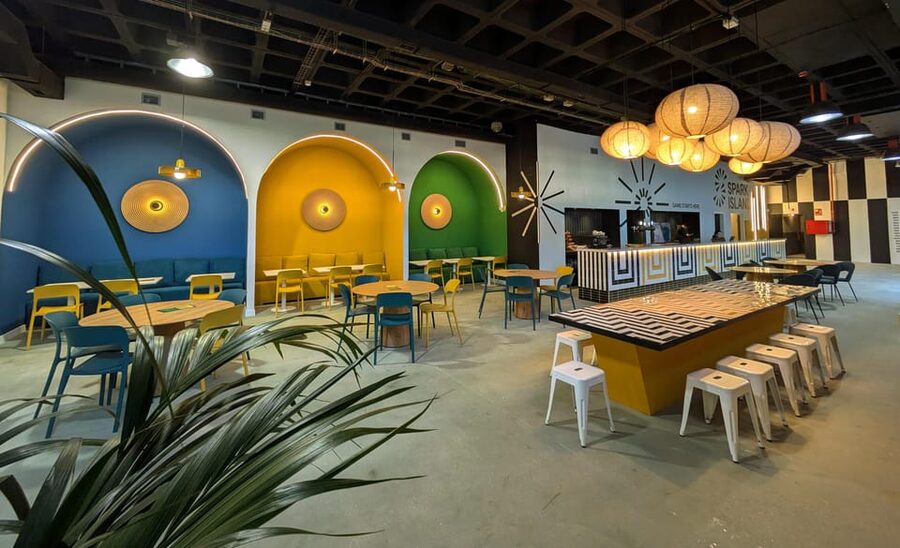
Look for the Spark Island sign outside the building. At the entrance, show your GetYourGuide voucher to the staff. The available host or greeter languages are English, French, and Spanish, so you can ask for basic instructions in one of those languages before entering the game area.
The venue describes the activity as lasting up to two hours, though the booking information also lists a one to two-hour duration depending on the available start time. Plan on reserving two hours so you are not pressed for time. One family completed all the cells in about an hour and a half, but that should not be treated as a guaranteed pace. Your result will depend on team size, how quickly you understand each task, and how many attempts you make.
There is no need to plan a formal route in advance. The useful preparation is simpler: arrive ready to listen, split responsibilities, and keep moving if a cell is not working for you. Since the challenge rooms use different skills, the strongest team is not always the one with the fastest person. It is the group that notices who is good at what.
How the 32 challenge cells work

Each cell presents a different test. The exact tasks are not listed, but the activity is built around three broad skill areas: technical, physical, and tactical.
Technical challenges may call for careful observation, quick problem-solving, or precise actions. Physical challenges can ask you to move, coordinate, or use agility. Tactical tasks reward a plan before your team starts pressing buttons, moving objects, or attempting a sequence.
You will need to communicate clearly. A useful team habit is to give each person a job. One player can read the task, another can watch for visual clues, and others can test the physical elements. If everyone tries to control the same challenge, you can lose time before the real puzzle even begins.
The cells have different themes, which keeps the session from feeling like 32 copies of the same room. You might find that your group races through one challenge and struggles with the next. That uneven rhythm is part of the appeal, but it also explains why the experience may feel demanding for anyone who prefers a calm, guided activity.
One point deserves a warning. The available information does not promise a clue system for every cell. A French-speaking participant specifically found that more hints would have helped with understanding the tasks. Go in expecting to work things out as a team, and ask the host for clarification if the instructions themselves are unclear.
Why the free movement changes the strategy
In a standard escape room, time spent stuck is time lost. In Prison Island, you can make a tactical choice: keep trying, or move to another cell and return later.
That makes the game more welcoming for larger groups and mixed abilities. You do not all have to crowd around one puzzle. If two people are working on a technical task, others can try a physical cell nearby. This gives everyone something to do and reduces the chance that one confident player takes over.
It also creates a real scoring strategy. You may choose to collect points from easier cells first, or spend time on harder challenges with a bigger potential payoff. The information provided does not specify how points are assigned, so you should listen closely to the venue’s briefing before deciding how competitive to be.
I would encourage you to treat the first few minutes as a scouting period. Try a cell, learn how the instructions work, and notice which teammates are good at observation, coordination, or quick decisions. Then settle into a plan. The leaderboard is more enjoyable when you understand how your score is being built.
More Madrid Tours:
- Madrid: Tour Bernabéu Entry Ticket
★ 4.5 · 21,573 reviews - Madrid: Prado Museum Entry Ticket
★ 4.6 · 17,509 reviews - Madrid: “Emociones” Live Flamenco Performance
★ 4.8 · 12,866 reviews - Madrid: Panoramic Route City Tour
★ 4.1 · 12,259 reviews
The two-hour rhythm and the final leaderboard
The full session allows enough time to sample many of the 32 cells rather than finishing after a single puzzle. Two hours can pass quickly, particularly when your group keeps returning to a challenge that is nearly solved.
You may not complete every cell. One 14-year-old pair of children did manage to complete all of them in about an hour and a half, but that is a strong result, not a standard promise. A team focused on scoring may spend longer on selected tasks instead of trying everything.
At the end, check the leaderboard to see how your team ranks. This gives the activity a satisfying conclusion and makes it easy to compare results among friends or colleagues. If you are arranging a birthday outing, family challenge, or work event, the leaderboard also supplies a natural final moment without requiring an additional activity.
Do not judge the session only by your final position. The better measure is whether everyone had a role. A lower score with the whole group involved can be more enjoyable than a higher score earned by two people while everyone else watches.
Who will enjoy Prison Island most
This is a strong choice for friends who like active games and do not want a conventional sightseeing stop. It also fits families with older children, especially those who enjoy testing themselves against parents or siblings.
The stated minimum age is 10. The activity is described as suitable from age 10 to 99, but the restrictions also say it is not suitable for people over 70. That is inconsistent guidance. If someone in your party is over 70, contact the provider before booking rather than relying on the broader age range.
The game can work well for corporate team-building because it exposes different working styles in a harmless setting. You quickly see who plans, who experiments, who keeps calm, and who communicates. Still, it is not a quiet team exercise. People who dislike competition, physical tasks, or timed problem-solving may find it tiring.
The experience is also suitable for a celebration such as a hen party. A French-speaking group used it for an EVJF and enjoyed having different themes in each room, along with the welcome at the venue. The format gives a large group something to do together without forcing everyone into one identical task.
Price, value, and what the ticket covers
At about $26 per person, the ticket buys up to two hours in the 32 challenge rooms. That is reasonable value if you want an active group activity rather than a short arcade game or a single puzzle room.
The strongest value comes from variety. You are not paying for one carefully staged challenge that may be over in 45 minutes. You get access to a large set of cells, and the open format lets your group choose how to spend the time.
The price does not include food or drinks. Plan to eat before or after the session if your group needs a full meal. You should also factor in the cost of getting to the venue in the Community of Madrid, since the supplied details identify the region but do not provide a transport route or nearby landmarks.
Book ahead if your visit depends on a particular time. The activity recommends advance booking, and you can reserve now and pay later. Free cancellation is available up to 24 hours before the scheduled experience for a full refund, which is useful when arranging a group outing.
What to wear and how to prepare

Wear comfortable clothes. This is not a sit-down puzzle activity, and the combination of physical, technical, and tactical tests means you may be moving around more than expected.
You do not need specialist equipment. The key preparation is mental and social:
- Agree that everyone gets a chance to lead.
- Move on from a difficult cell instead of arguing with it.
- Listen to the instructions before acting.
- Use the team’s different strengths.
- Keep track of time so you do not spend the whole session on one challenge.
The activity can be played in English, French, or Spanish through the host or greeter. If your group is multilingual, confirm that everyone understands the briefing before starting. Clear instructions are especially important because the cells do not all follow the same pattern.
The main strengths and the fair warning

The best part of Prison Island is the range of play. A single group can shift from problem-solving to physical coordination to team tactics within the same session. That variety gives people different ways to contribute.
The second major strength is the free-choice format. You can leave a cell and return later, so one failed attempt does not ruin the whole outing. The points and leaderboard then add a simple goal without requiring a complicated story.
The main caution is that the format may not hold your hand. Some teams will enjoy working out what to do. Others may want more direct clues and a clearer route. If your ideal escape room includes frequent staff guidance, ask how hints work before you begin.
The activity also has an age limitation that needs clarification. The stated minimum is clear at 10, but the older age wording is not. That is a small booking issue, yet it matters if your group includes older family members.
Should you book Prison Island in Madrid?
Book it if you want a hands-on group challenge with many different tasks, a competitive score, and enough freedom to shape your own session. It is particularly well suited to families with children aged 10 and up, friend groups, hen parties, and work teams.
Think twice if you want a guided story, a quiet indoor activity, or a puzzle room with constant clues. Prison Island asks you to experiment, communicate, and keep moving. At $26 per person, it offers solid value for an active two-hour outing, provided your group enjoys the game rather than needing every challenge explained immediately.
FAQ
Where is Prison Island located?
The activity is in the Community of Madrid, Spain. Look for the Spark Island logo on the building and show your GetYourGuide voucher at the entrance.
How long does the experience last?
The activity is listed as lasting one to two hours, with the ticket including up to two hours in the 32 challenge rooms.
How many rooms are included?
The experience includes 32 challenge rooms, also called cells. Each one presents a different task or theme.
What types of challenges are included?
The game combines technical, physical, and tactical skills. You will need teamwork, strategy, and problem-solving ability.
Can I move between rooms?
Yes. Prison Island is not a single-route escape room. Your team can move between challenges and return to cells as you choose.
What languages are available?
The host or greeter can assist in English, French, or Spanish.
What should I wear?
Wear comfortable clothes, since the game includes physical and active challenges.
Is the activity suitable for children?
Children under 10 are not suitable for this activity. The information also gives conflicting guidance for older participants, describing the experience as suitable up to age 99 while stating that it is not suitable for people over 70. Confirm the age policy with Spark Island if needed.
Just added around Madrid
- Visit the National Archaeological Museum in Madrid★ 4.4 · 6 reviews
- From Madrid: Parque Warner Beach Water Park & Transport★ 3.9 · 14 reviews
- Madrid Wine Tasting, Flamenco Class and Pub Crawl★ 4.5 · 6 reviews
- Virtual Reality Experience Fun And Tickets & Imageen★ 5.0 · 12 reviews
- Visit to the Prado Museum★ 4.9 · 6 reviews
- Tuk Tuk Tour with Wine Test in Madrid★ 3.8 · 6 reviews
- Tuktuk historical tour of Madrid 1 Hr in a fun and original way★ 3.7 · 3 reviews
- Prado Museum VIP tour with an art Expert, tickets included★ 5.0 · 11 reviews
Madrid Escape Rooms and Games, compared.



Browse the lists this tour appears in