
Reviewed · MADRID
Spanish Civil War start of 2 World War, Guernica Franco
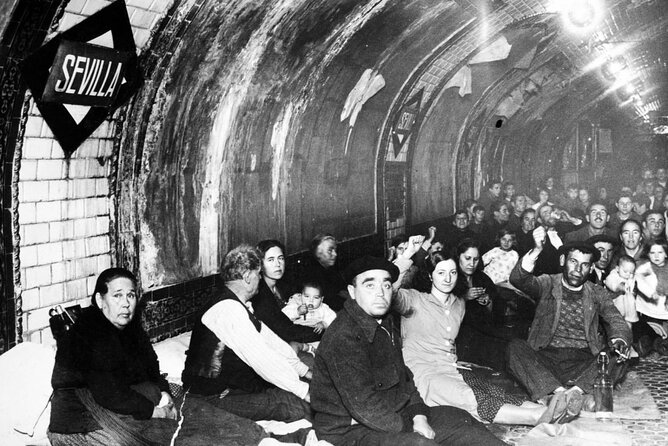
Madrid’s Civil War story is written into the city streets. This 2.5-hour walking tour links bomb-scarred buildings, the Senate, the Temple of Debod, Picasso’s Guernica, and Franco’s Victory Arch to show how Madrid became both a battlefield and a political symbol.
I like the route’s clear connection between military events and ordinary life, including cinemas, wartime sayings, music, money, propaganda, and emergency blood transfusions. I also like the use of maps, images, audio, and video, which helps you picture places that no longer look as they did in the 1930s.
The main drawback is the subject’s density. Seven stops in a little over two hours means you get a strong overview rather than a full study of every faction, battle, or memorial. The walk also ends at Moncloa, away from central Madrid.
Key points to know before you book
- The route runs from Plaza del Callao to the Victory Arch, covering central Madrid and Moncloa.
- The tour connects the Civil War to World War II and Franco’s dictatorship, rather than treating the conflict as an isolated event.
- Picasso’s Guernica is discussed at Paseo del Pintor Rosales, alongside civilian bombing and the Prado’s wartime protection.
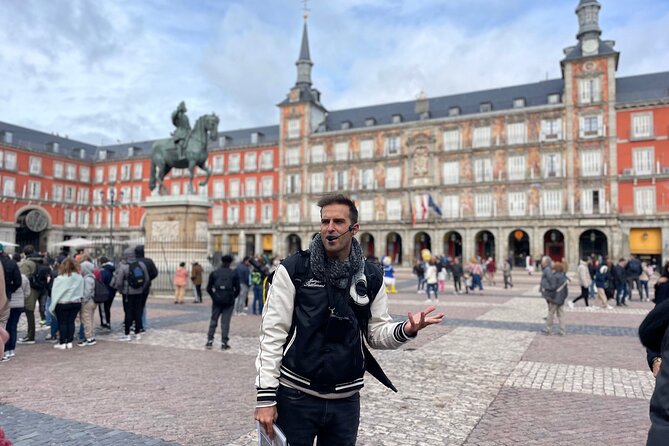
- The guide uses maps, photographs, audio, and video, making the talk easier to follow at outdoor stops.
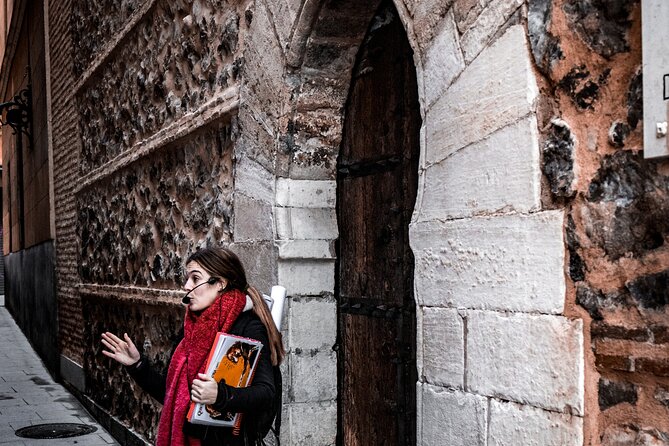
- Named guides include Victor, Maikel, Guillermo, Adria, and Chato, although your assigned guide may differ.
- The listed price is $3.62 per group of up to 15, with a maximum activity size of 30 people, so confirm the current booking details before paying.
Why this Madrid Civil War walk is worth your time
I like tours that use a city as their classroom, and this one does that well. Instead of placing the Spanish Civil War behind museum glass, it takes you to locations tied to bombing, government, resistance, propaganda, art, military command, and victory.
You begin near Plaza del Callao and finish by the Arco de la Victoria. That physical movement matters. Madrid changes as you walk, and the route gives you a sense of how the conflict reached the city center, the government quarter, the western edge of the capital, and the symbolic monument at Moncloa.
The tour is also useful if you know only the broad outline: Republicans on one side, Franco’s Nationalists on the other, and a country split by competing political visions. Your guide explains how the war began, how Madrid endured a long siege, and how the conflict helped set the stage for World War II and decades of dictatorship.
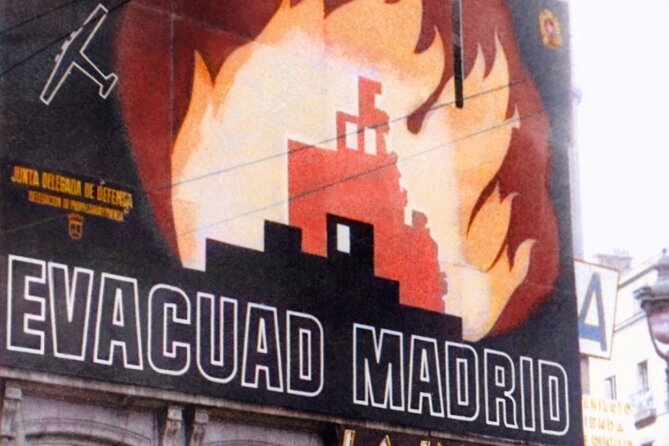
The supplied material is designed for an outdoor walk. You receive maps, images, audio, video, and other exclusive material, rather than relying on spoken explanation alone. That is important here. A modern Madrid street rarely looks like a wartime photograph, so visual comparisons help connect today’s buildings with the events being discussed.
More Madrid Tours:
- Madrid: Tour Bernabéu Entry Ticket
★ 4.5 · 21,573 reviews - Madrid: Prado Museum Entry Ticket
★ 4.6 · 17,509 reviews - Madrid: “Emociones” Live Flamenco Performance
★ 4.8 · 12,866 reviews
Plaza del Callao: bombings in the heart of Madrid
The first stop is Plaza del Callao, one of the city’s busiest central squares. Here the discussion turns to bombing in central Madrid and the scars still visible on some buildings.
This is an effective opening because it starts with the city itself. You are not asked to memorize names and dates before understanding the human scale of the conflict. The guide also considers what daily life looked like for a Spaniard at war, including a striking question: would you still go to the movies?
That detail gives the first section an everyday focus. War was not only fought by soldiers at the front. People had to decide how to work, move around the city, seek shelter, find food, and keep some form of normal routine.
Allow about 15 minutes here. The stop is short, so you should expect a focused introduction rather than a long examination of each damaged building. If you want a detailed architectural record of wartime damage, this tour will not provide that level of study. It does, however, establish the central idea that Madrid’s civilian spaces were part of the conflict.
Palacio del Senado: how Spain split in two
At the Palacio del Senado, the tour tackles the difficult question of how the Spanish Civil War started. This is where the walk moves from visible damage to the political divisions behind it.
The phrase two Spains helps frame the conflict, though the reality was more complicated than two neat camps. The tour addresses the Civil War as a struggle between competing political and social forces, then places Spain in the wider European setting.
The stop also presents Spain as a testing ground for World War II. That connection is one of the most useful parts of the experience. It helps explain why the war matters beyond Spanish borders and why Madrid’s conflict became an international concern.
You have about 20 minutes here. That gives your guide enough time to explain the causes and factions without turning the stop into a university lecture. Still, you should expect a broad account. If you already have a strong grasp of Spanish politics in the 1930s, you may want more detail about individual parties and foreign involvement than a short walking tour can offer.
Plaza de España: Franco and the long defense of Madrid
Plaza de España brings the story to Francisco Franco and the defense of the capital. The tour describes Madrid’s 900 days of siege, a figure that gives the conflict a sense of endurance rather than a single dramatic clash.
This section also looks at life in Madrid under bombardment and at wartime sayings. Those small phrases can reveal how people made sense of fear, shortages, uncertainty, and political pressure. I appreciate that the program includes language and daily habits, not just commanders and battle lines.
The stop lasts around 15 minutes. Plaza de España is a major public space, so the setting may feel less intimate than a tucked-away street or memorial. That is part of the point: the tour shows how war entered places used by ordinary city residents.
Franco’s role needs careful handling, and the guide’s job is to place him within the wider conflict rather than reduce the story to one man. The walk then continues to the western side of central Madrid, where money, propaganda, art, and memory come together.
A different sort of day out around Madrid:
- Madrid: Panoramic Route City Tour
★ 4.1 · 12,259 reviews - Madrid: Live Flamenco Show with Food and Drinks Options
★ 4.5 · 9,901 reviews - Avila & Segovia Tour with Tickets to Monuments from Madrid
★ 5.0 · 9,762 reviews - Three Cities in One Day: Segovia, Avila and Toledo from Madrid
★ 5.0 · 8,402 reviews
Templo de Debod: paying for war and shaping opinion
The Temple of Debod is an unusual setting for a Spanish Civil War discussion. The monument itself is not a Civil War battlefield, but the stop uses the area to examine who paid for the war and how propaganda turned the conflict into a war of ideas.
That is a useful shift. Armies need money, supplies, and outside support, while governments need stories that persuade people to keep fighting. By pairing finance with propaganda, the tour shows that war depends on more than weapons.
The surrounding site also includes the Sculpture to the Fallen of the Civil War. That brings the conversation back to memory and mourning. You are not simply told what happened; you are asked to consider how Madrid remembers the dead and how public monuments shape the way later generations see the conflict.
Plan on roughly 20 minutes. The stop gives your guide room to use the supplied visual material, which is especially helpful for propaganda and financial themes. One limitation is that the Temple of Debod itself may attract your attention for reasons unrelated to the tour. If you want a full visit to the temple, treat that as a separate plan rather than expecting this walk to focus on ancient Egypt.
Paseo del Pintor Rosales: Guernica, civilians, and art under fire
Paseo del Pintor Rosales is the emotional center of the walk. Here the guide discusses Picasso, Guernica, and the bombing of civilians.
The value of this section is that it treats art as evidence of public shock and political response, not as a detached museum topic. Picasso’s painting is tied to the wider question of what happens when civilian areas become targets and how artists respond to violence.
The discussion also turns to the Prado Museum and art under fire. That broadens the idea of cultural heritage during wartime. Paintings, buildings, and public symbols can be threatened even when they are not military targets.
The stop lasts about 20 minutes. You will not be visiting the Prado as part of this route, and the itinerary does not include entry to any paid site. Instead, you receive context outdoors, supported by images and other material from the guide.
This is a good section for anyone interested in art, museums, or the way political events shape culture. It is also where the tour’s human focus becomes clearest. A bombing is not just a movement on a map. It changes families, neighborhoods, memory, and the way the outside world sees a country.
The stop includes the idea of Christmas during a truce, described as a brief breathing space in the war. That detail gives the subject a quieter moment. It reminds you that even during a brutal conflict, people still marked holidays and looked for temporary relief.
Cuartel General del Ejército del Aire: medicine, music, and the war’s aftermath
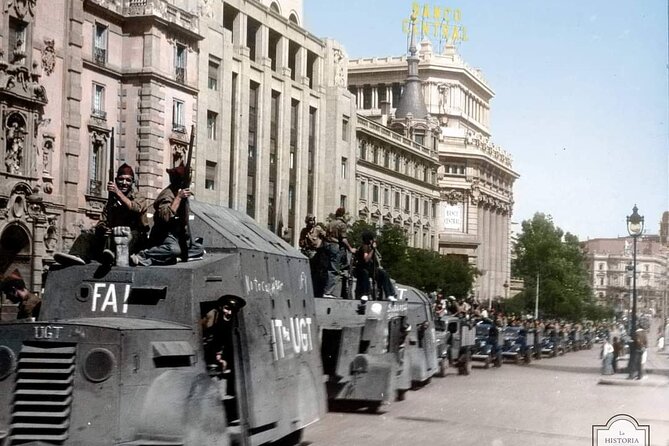
At the Cuartel General del Ejército del Aire, the tour turns to music, military culture, and the first remote blood transfusion. The medical detail is particularly striking because it shows practical innovation in the middle of mass suffering.
The tour also mentions They Won’t Happen and Sun Face, songs linked to the political atmosphere of the period. Music can carry ideology quickly, and these references help explain how the war was heard as well as seen.
The medical story gives the stop a different texture from the earlier discussions of bombing and propaganda. You are shown how people tried to save lives while cities and armies were under pressure. It is a compact way to connect science, logistics, and human survival.
The final topic here is especially important: the end of the Spanish Civil War, the beginning of World War II, and the start of dictatorship. The wording does not mean the two wars were the same conflict. It points to the wider historical transition and to the fact that Spain entered a long authoritarian period after its own war ended.
Allow around 15 minutes. This is enough for a clear explanation, though not for an extended study of wartime medicine or political music. If those subjects interest you most, note them down for further reading after the walk.
Arco de la Victoria: a difficult monument at the finish
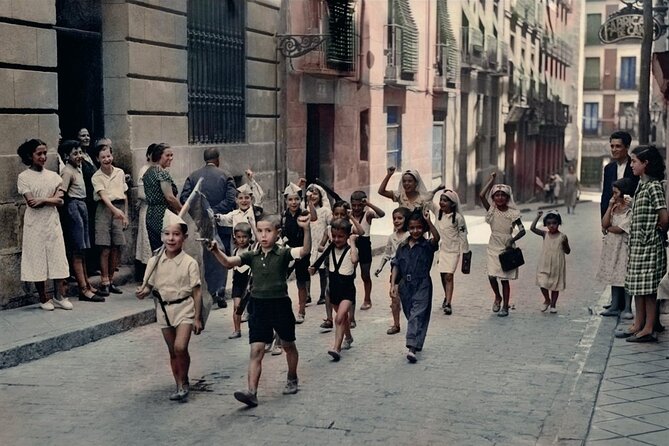
The tour ends at the Victory Arch, or Arco de la Victoria, near Moncloa. The guide asks whether the monument should be destroyed or preserved, then uses it to reflect on war and public memory.
This is a strong ending because the arch is not treated as a simple victory marker. Its presence raises a practical question: what should a city do with monuments tied to a dictatorship and a divided past?
You may not leave with a single answer, and that is useful. Madrid’s memorial choices are part of the story. Preserving a monument can keep an uncomfortable past visible. Removing or altering it can change the public message. The tour gives you a way to think about that tension rather than presenting memory as settled.
The final stop takes about 20 minutes and ends at Arco de Moncloa, Av. de la Memoria, 32. Moncloa metro is nearby, so you can continue by public transport after the walk. Since the route ends outside the historic center, plan your next stop before you arrive.
Price, group size, and what you receive
The listed price is $3.62 per group of up to 15, which is unusually low for a guided experience lasting about two and a half hours. At that rate, the value is excellent if the price shown during your booking is current and accurate.
The activity information also gives a maximum of 30 participants. Those two figures may describe different booking arrangements, so I would check the final confirmation carefully. A smaller private group of up to 15 would allow more questions and a closer exchange with the guide. A larger group of up to 30 could feel less personal, particularly at busy public stops.
There are no required entry fees for the sites on this route. The experience includes a local guide, visual and audio material, and a link to personalized ideas for things to do in Madrid. You are also told that the guide offers personalized attention after the tour, which can be useful if you want suggestions for the rest of your stay.
Tips are not included. The tour information frames gratuities as a way to value the guide’s effort, so bring a little cash if you feel the walk earned it.
Who should book this walk?
I would choose this tour if you want a clear first understanding of the Spanish Civil War in Madrid. It suits you especially well if you like history explained through streets, monuments, art, and personal details rather than through a museum display alone.
It is also a good fit for anyone interested in Franco, Picasso, political propaganda, military medicine, or how cities remember civil conflict. The route gives each subject a place and connects them into one story.
You should think twice if you want a highly specialized military tour. Seven stops in 150 minutes means the guide must keep moving. You will get an overview with useful detail, not a full account of every battle, political faction, foreign power, or postwar event.
The quality of the experience will also depend on the guide’s delivery. Victor is described as combining information with a light, engaging manner. Maikel uses historical landmarks and visual material to explain the causes, events, and social effects of the war. Adria is described as clear, personal, authentic, and sensitive, while Chato is noted for giving extra time and continuing beyond the planned 2.5 hours. Guillermo is also named as a guide who helps connect the Civil War sites with Madrid itself.
Guide assignments can vary, so you should not book solely for one individual unless the provider confirms that person. Still, these details show the kind of approach you can expect: direct explanation, visual support, and room for questions.
Should you book the Madrid Civil War tour?
Book it if you want the essential story of Madrid’s Civil War told on foot, with strong links to Picasso, Franco, propaganda, civilian bombing, and the road to World War II. The route is thoughtful, the price is attractive as listed, and the outdoor format makes the city part of the lesson.
Skip it if you want entry to museums, long time at individual monuments, or a narrow specialist study of military operations. For most visitors with a few hours to spare, though, this is a useful way to understand why Madrid looks and feels the way it does, and why the Civil War still shapes public memory in Spain.
FAQ
Where does the tour start?
It starts at C. del Postigo de San Martín, 26, in Madrid’s Centro district.
Where does the tour end?
The walk ends at the Arco de la Victoria on Av. de la Memoria, 32, in Moncloa. Moncloa metro is nearby.
How long does the experience last?
The planned duration is approximately 2 hours and 30 minutes.
Is the tour offered in English?
Yes. The experience is offered in English and includes a local guide.
Are tickets to the sites included?
There are no required site-entry tickets for this walking route. The listed experience does not include entry to museums or other paid attractions.
Can I cancel for a full refund?
Yes, if you cancel at least 24 hours before the experience start time. Cancellations or changes made less than 24 hours before the start are not refunded or accepted.
Just added around Madrid
- From Madrid: Parque Warner Beach Water Park & Transport★ 3.9 · 14 reviews
- Madrid Wine Tasting, Flamenco Class and Pub Crawl★ 4.5 · 6 reviews
- Visit the National Archaeological Museum in Madrid★ 4.4 · 6 reviews
- Virtual Reality Experience Fun And Tickets & Imageen★ 5.0 · 12 reviews
- Visit to the Prado Museum★ 4.9 · 6 reviews
- Tuk Tuk Tour with Wine Test in Madrid★ 3.8 · 6 reviews
- Tuktuk historical tour of Madrid 1 Hr in a fun and original way★ 3.7 · 3 reviews
- Prado Museum VIP tour with an art Expert, tickets included★ 5.0 · 11 reviews