
Reviewed · CYCLING TOURS
Madrid City Tour | Regular Bike or E-Bike | Reduced Groups
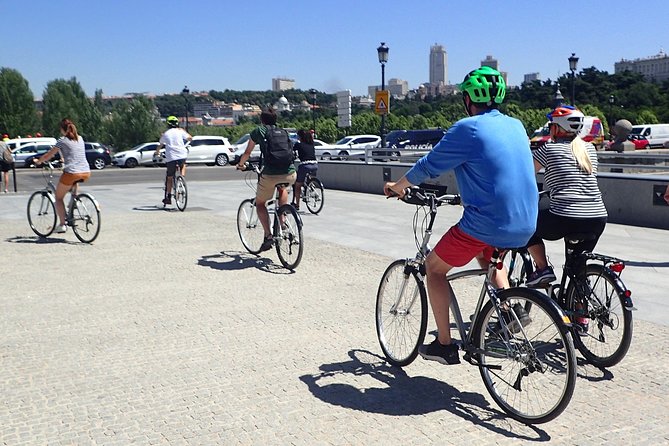
Madrid makes sense from a bicycle seat. In about three hours, you can roll from the Royal Palace through La Latina, the Literary Quarter, the Paseo del Prado, El Retiro, Chueca, Malasaña, and the Temple of Debod. It is a brisk way to get your bearings before choosing where to return on foot.
I like the wide range of sights and the chance to ride through places that feel like real neighborhoods, not just photo stops. I also like that a guide, bicycle, helmet, and tour photos are included, while the group is kept relatively small. The main caution is that Madrid has hills, traffic, and a lot of ground to cover, so commentary can be hard to hear and the route may feel rushed.
Key points at a glance
- A three-hour city sampler: Cover royal Madrid, art museums, old neighborhoods, El Retiro, Chueca, Malasaña, and the Temple of Debod.
- Choose your effort level: A regular bicycle is available, but an e-bike may be the wiser pick for Madrid’s hills.
- El Retiro gets real riding time: About 30 minutes are set aside for the park, lake, Crystal Palace, and Alcalá Gate.
- Small-group format: The tour is advertised with a maximum of 10 or 15 people, depending on the booking details, so confirm the current cap.
- Strong guide element: Sergio, Juan Filipe, Remy, and Alboran have each led highly praised outings, with special credit for warmth, helpfulness, and local context.
- Good first-day activity: You see enough of Madrid to mark places you want to revisit at a slower pace.
Why a bicycle works so well in Madrid
Madrid is too spread out for a pleasant walking tour that tries to cover all these districts in one afternoon. A bicycle lets you connect the royal center, museum quarter, grand boulevards, parks, and northern neighborhoods without spending the day underground or in taxis.
The route is not a gentle spin around one park. It is a city ride with changing surfaces, traffic, hills, and frequent stops. You will see major landmarks, but the real appeal is the connection between them. One minute you are beside a royal palace, and soon after you are pedaling through an old market district or a modern nightlife quarter.
I would book this early in your stay. Sergio’s approach, in particular, has been praised for giving people a useful sense of the city, while Remy is credited with covering the main sights efficiently. That makes the tour a practical orientation ride, not just a sightseeing loop.
The experience is offered in English, though the guide may be multilingual. You should expect a group ride rather than a private lesson in Spanish history. The best guides add short, clear explanations at each stop, but you may need to stay close to hear everything.
More Madrid Bike Tours:
- Madrid Highlights Bike Tour
★ 5.0 · 1,731 reviews - Best of Madrid: 3-Hour Guided Bike Tour in Small Groups
★ 4.8 · 1,417 reviews - Madrid: Highlights Guided Vintage Bike Tour and Tapas Option
★ 4.9 · 962 reviews
Starting at Bravo Bike near Moncloa
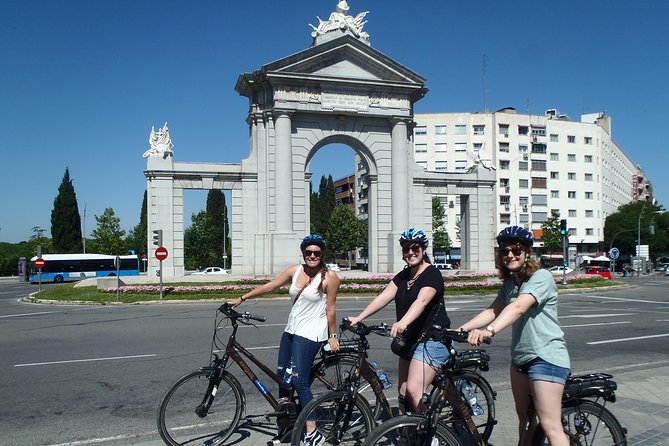
The tour begins at Bravo Bike on Calle de Juan Álvarez Mendizábal, 19, in the Moncloa-Aravaca area. Bravo Bike has operated bicycle tours in Madrid since 1999, and the company also runs rides to places such as Segovia, Toledo, Ávila, El Escorial, Aranjuez, and Chinchón.
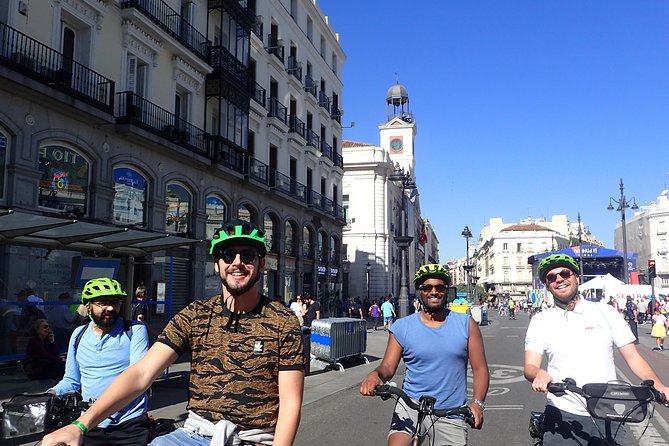
At the start, you receive a city bicycle and helmet. The price also includes a local guide and tour photographer, along with the photos taken during the ride. Transportation to the attractions is not included because you are making the connections by bicycle, and insurance is also excluded.
The published details give two different group limits, one saying 15 people and another saying 10. That is worth confirming when you book. Either way, this is intended to be a reduced-group experience, not a large bike parade.
You need a moderate level of physical fitness. Children must ride with an accompanying adult, and the company says the route may be adjusted for children with good cycling skills. For a family, the traffic and hills deserve serious thought. A family that rides comfortably may enjoy the quick changes of scene, while a less confident cyclist may prefer the company’s river and parks route.
Royal Palace and the old western center
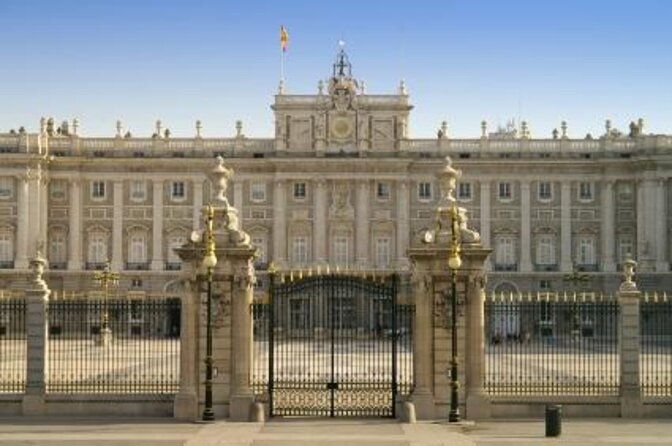
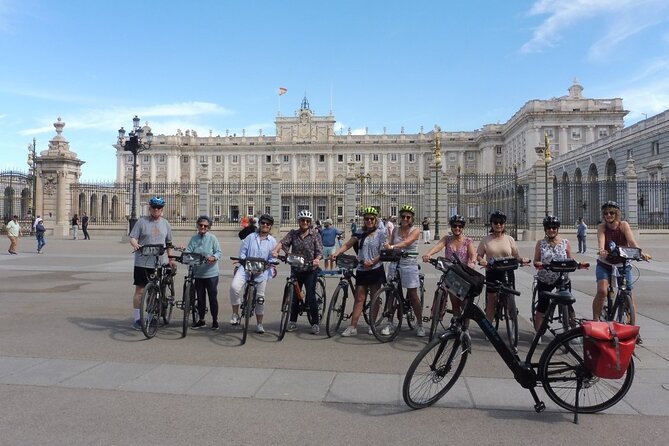
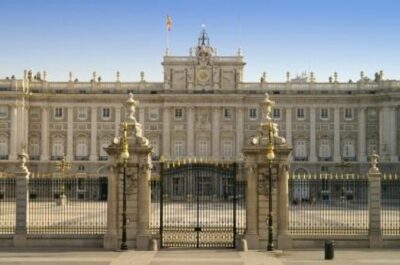
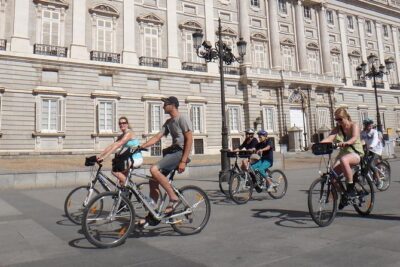
The Royal Palace is an impressive first major landmark. It occupies the site of the old Alcázar of Madrid, which was destroyed by fire on Christmas Eve in 1734. A new palace followed under Felipe V, using plans first developed by Filippo Juvarra and later changed by his pupil Giambattista Sacchetti.
You do not go inside on this tour, and admission is not included. The stop is about seeing the exterior, understanding its place in Madrid, and moving on. That is useful if you want a broad city survey, but it will not replace a palace visit. If the interior is a priority, set aside another part of your trip for it.
From here, the ride moves toward La Latina. This is one of the more rewarding parts of the route because its narrow streets and irregular layout reflect the older city. The area grew outside the medieval walls and developed around commerce and markets.
Names such as Plaza de la Cebada, Plaza de los Carros, and Plaza de la Paja preserve links to old trades and goods. El Rastro, Madrid’s famous flea market, also belongs to this district. The bike stop is brief, but it gives you enough context to return later for a longer wander or a meal around Cava Baja.
Literary streets and the Paseo del Prado
The Barrio de Las Letras brings a different kind of Madrid into view. During Spain’s Golden Age of literature, writers including Cervantes, Lope de Vega, Quevedo, Tirso de Molina, and Góngora lived in this area.
You will not get a full literary walking tour here. Instead, the bicycle gives you a quick look at the streets and squares tied to some of Spain’s most important writers. I like this stop because it prevents the ride from becoming a checklist of royal buildings and museums. Madrid’s identity is also found in its writers, taverns, and neighborhood streets.
Next comes Paseo del Prado, the broad, tree-lined avenue at the heart of Madrid’s art district. Along roughly two kilometers, the Prado Museum, Thyssen-Bornemisza National Collection, and Reina Sofía Museum form the so-called Golden Triangle of Art.
The ride does not include museum admission. That is a sensible arrangement for a three-hour cycling tour, since entering even one major museum would break the rhythm of the day. Instead, you get the setting and a guide’s explanation, then you can return to the museum that interests you most.
The boulevard began as an open meadow near the San Jerónimo el Real monastery. Later, the area changed under royal development, including the Buen Retiro Palace commissioned by Felipe IV. The guide can connect that royal past with the museums and public spaces you see today.
A different sort of day out around Madrid:
- Madrid: Tour Bernabéu Entry Ticket
★ 4.5 · 21,573 reviews - Madrid: Prado Museum Entry Ticket
★ 4.6 · 17,509 reviews - Madrid: “Emociones” Live Flamenco Performance
★ 4.8 · 12,866 reviews - Madrid: Panoramic Route City Tour
★ 4.1 · 12,259 reviews
Thirty minutes in El Retiro Park
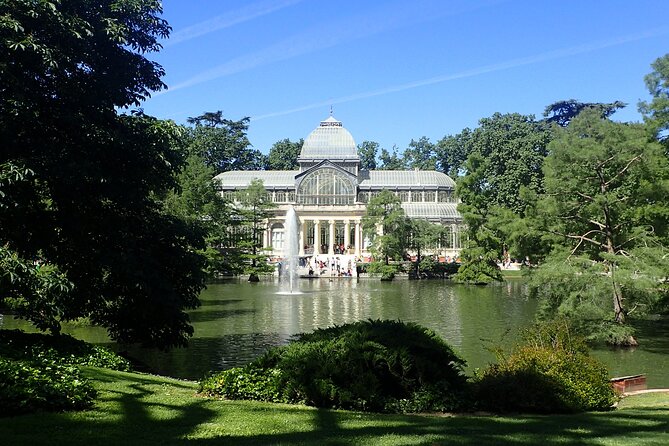
El Retiro is the route’s longest stop, with about 30 minutes in the park. That extra time matters. You ride along the French parterre toward the large lake, called the Estanque, then continue toward the Crystal Palace.
The park began as a royal garden in the 17th century. Its Crystal Palace is an elegant glass-and-iron building first used to display exotic plants and flowers from the Philippines. You see it as part of the ride rather than as an indoor museum visit.
There may be an optional refreshment break near the lake. Do not count on a long café stop, but the pause can make the park section feel less hurried. You then leave through the Alcalá Gate, one of Madrid’s best-known monuments.
This is the part of the tour most likely to please people who want a little breathing room. The park offers a change from city streets, and the lake and palace create strong photo stops. It is also a reminder that you are still exercising. You need to watch your bike, other riders, pedestrians, and the group’s pace.
Plaza de Colón, Salamanca, and Malasaña
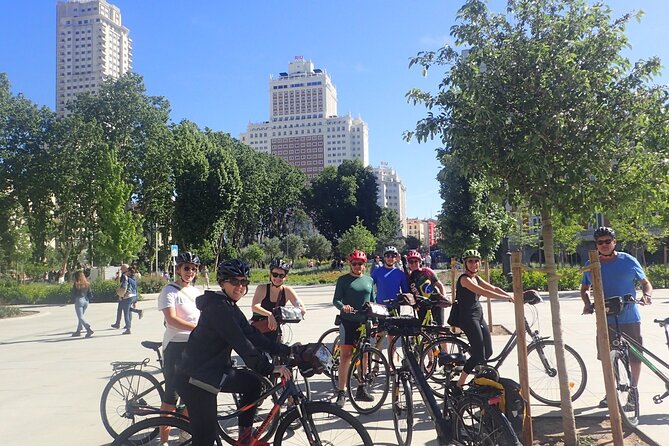
After El Retiro, the route reaches Plaza de Colón and the Salamanca district. Calle Serrano is known for fashionable shopping, while Mercado de la Paz is one of the area’s food markets. Platea, on Calle Goya opposite the plaza, combines food stalls and tapas.
This section is less about ancient monuments and more about how Madrid lives today. The brief stop lets you note places for later, especially if you want shopping or a more polished food market.
The ride then reaches Malasaña, named for Manuela Malasaña, associated with the uprising of 2 May 1808 against Napoleon’s occupation. Plaza del Dos de Mayo commemorates that revolt and the officers Luis Daoíz and Pedro Velarde.
Malasaña later became a center of the movida madrileña, the creative movement that transformed Madrid’s arts and nightlife in the 1980s. It is a good example of the route’s range: the same afternoon touches royal power, literary history, war, and modern counterculture.
You only spend about five minutes at the Malasaña stop, so you should not expect a detailed neighborhood walk. Think of it as a useful introduction. If the district catches your interest, return without a bicycle and explore its shops, cafés, and bars at a slower pace.
Chueca and the Temple of Debod
Chueca is another lively central district, known for boutiques, bars, cafés, and traditional taverns. The San Antonio international food market gives the area a strong food angle, while Augusto Figueroa Street is associated with shoe shops and small businesses.
The stop at Plaza de Chueca lasts about 10 minutes. That is enough for a short explanation and a look around, but not enough to sample the market properly. You may want to make a note of the area for a later evening.
The final major sight is the Temple of Debod in Parque del Oeste. Egypt gave the ancient temple to Spain, and it was reassembled in Madrid in the early 1970s. Its setting is unusual: an Egyptian monument on a Madrid hilltop with views toward Casa de Campo and the Sierra de Guadarrama.
The temple is also known for sunset views. The tour is scheduled in the afternoon, but the exact timing may not line up with sunset, so do not assume you will see the site in its best evening light. Still, it is a memorable ending because it feels entirely different from the palace, museums, and old quarters earlier in the ride.
From there, the activity returns to the Bravo Bike meeting point. You are not dropped at the temple or another central location, so plan for the ride back and for your next activity.
Regular bicycle or e-bike?
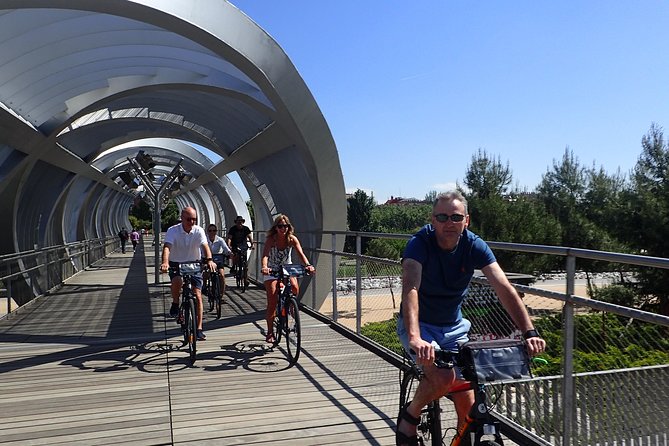
The e-bike is worth serious consideration. One particularly strong account of the ride praised Alboran and specifically advised choosing the electric bicycle because Madrid has a lot of hills.
That advice fits the route. You cover a large portion of the city, and the ride includes districts at different elevations. An e-bike can reduce the strain and help you keep up without turning the afternoon into a test of endurance.
A regular bicycle may suit you if you cycle often and enjoy a little effort. The tour requires moderate fitness, not racing ability, but you should not treat it as a flat park ride. Ask about the available bicycle options when booking, especially if you are traveling with children or anyone who is unsure about hills.
The helmet is included. You should dress for the weather because the tour operates in all conditions. Madrid’s sun, wind, or rain can change how comfortable the ride feels, and there is no promise of a weather cancellation.
Guide quality and the group experience
The guide is central to the value here. Sergio has been praised for being inviting, engaged, and attentive, with a style that works well for first-day orientation. Juan Filipe has been singled out for his historical explanations and kind manner. Remy is credited with being informative and helpful, while Alboran received strong praise from an e-bike rider.
Those names are useful when you book, but guides can vary by date. The best way to enjoy the ride is to stay close at stops and speak up if you cannot hear. One account found the commentary difficult to follow because the group spread out and the guide was not always easy to hear.
That is a fair limitation of city cycling. You are watching traffic and navigating streets, not sitting in a museum room. A smaller group helps, but it does not remove the need to keep together. If historical detail is your main goal, you may prefer a dedicated walking tour or museum visit later.
The overall rating is 4.8 from 75 ratings, with 96 percent recommending the experience. Those figures support the idea that this is a dependable introduction, while the lower-scoring comments point to the same practical issue: the ride can be excellent, but the amount of commentary you receive depends on the guide, group spacing, and how well you can hear.
Is the $42.24 price good value?
At $42.24 per person, the tour is reasonably priced for three hours of guided sightseeing with a bicycle, helmet, local guide, and photos. You are paying for movement between widely separated parts of Madrid, not for admission to museums or the Royal Palace.
The strongest value comes from the coverage. Seeing the palace, La Latina, the art district, El Retiro, Salamanca, Malasaña, Chueca, and the Temple of Debod independently would require several walks and careful transport planning. The bicycle handles the connections for you.
The price is less attractive if you want long visits at each landmark. Most stops last about five to 10 minutes, with El Retiro receiving roughly half an hour. You should think of this as a city overview with short explanations, not a series of in-depth guided visits.
Group discounts may be available. Free cancellation is offered if you cancel at least 24 hours before the start time. Changes or cancellations inside that window are not accepted for a refund.
Who should book this ride?
I would choose this tour if you want an active first look at Madrid and are comfortable cycling in a city. It works especially well for couples, friends, and families with children who already ride confidently.
It also suits anyone who wants help deciding how to spend the rest of a Madrid visit. You can mark the Prado, El Retiro, Cava Baja, Chueca, Mercado de la Paz, or the Temple of Debod for a return visit.
I would think twice if you dislike hills, need a slow pace, or want detailed historical commentary at every stop. The route covers a lot, and some of the most interesting neighborhoods receive only a few minutes.
FAQ
How long does the Madrid bike tour last?
The activity lasts approximately three hours and ends back at the Bravo Bike meeting point.
Where does the tour begin?
It begins at Bravo Bike, Calle de Juan Álvarez Mendizábal, 19, in Madrid’s Moncloa-Aravaca area.
Is an e-bike available?
Yes. You can choose a regular bicycle or an e-bike. An e-bike may be useful because the route includes hills.
Are museum or Royal Palace tickets included?
No. Admission to the Royal Palace and museum sites is not included. The tour views these places from outside and does not provide attraction transportation.
What is included in the price?
The price includes a local guide and photographer, city bicycle, helmet, GST, and tour photos. Insurance and transportation to or from attractions are not included.
Can children join the tour?
Yes, but children must be accompanied by an adult. The tour requires moderate physical fitness, and the company says the route can be adapted for children with good cycling skills.
Should you book it?
Book this ride if you want to see a large slice of Madrid quickly, prefer active sightseeing, and can manage a few hills. The combination of El Retiro, the old center, art district, literary streets, Chueca, Malasaña, and the Temple of Debod gives you a useful first map of the city.
Choose the e-bike if you are unsure about the effort. Stay close to the guide, ask for help if you cannot hear, and treat the short stops as introductions rather than full visits. Done that way, this is a smart first afternoon in Madrid, with enough variety to show you where you want to spend more time later.
Just added around Madrid
- From Madrid: Parque Warner Beach Water Park & Transport★ 3.9 · 14 reviews
- Madrid Wine Tasting, Flamenco Class and Pub Crawl★ 4.5 · 6 reviews
- Visit the National Archaeological Museum in Madrid★ 4.4 · 6 reviews
- Virtual Reality Experience Fun And Tickets & Imageen★ 5.0 · 12 reviews
- Visit to the Prado Museum★ 4.9 · 6 reviews
- Tuk Tuk Tour with Wine Test in Madrid★ 3.8 · 6 reviews
- Tuktuk historical tour of Madrid 1 Hr in a fun and original way★ 3.7 · 3 reviews
- Prado Museum VIP tour with an art Expert, tickets included★ 5.0 · 11 reviews
Cycling Tours, compared.
Best of Madrid: 3-Hour Guided Bike Tour in Small Groups
Read our review →
Highlights Guided Vintage Bike Tour and Tapas Option
Read our review →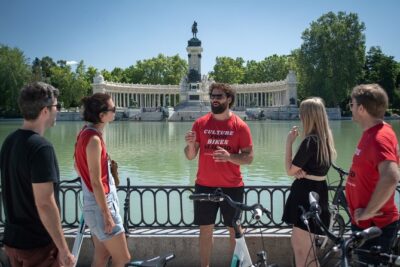
3 hour Guided Highlights Bike Tour with Optional Tapas
Read our review →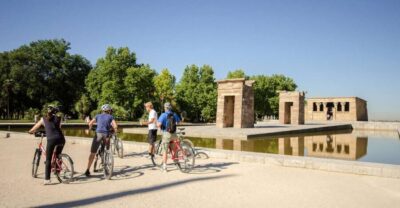
Madrid City Guided Bike/E-Bike Tour for Small Groups
Read our review →
Browse the lists this tour appears in