
Reviewed · DON QUIXOTE WINDMILL TOURS
Don Quixote Quest Experience in Madrid
Madrid’s old center becomes a puzzle board in this self-guided Don Quixote game, which links grand squares, writers’ homes, churches, and small historic corners. You follow prompts on your phone, solve a challenge at each stop, and earn the next location without a physical guide leading the way.
I like the private format, since your group can stop for coffee, take photos, or argue over a clue without holding up strangers. I also like the very low price, about $8.40 per person, and the fact that you can play offline. The main caution is that some directions may not reflect current construction, so you should expect to use your eyes and judgment along the way.
Key points at a glance
- A literary route through central Madrid: Connect with Cervantes, Lope de Vega, Goya, Calderón de la Barca, and Federico García Lorca.
- A private game for your group: No physical guide joins you, and no outside group shares your activity.
- Flexible two-hour format: Start at any hour, pause whenever you like, and resume later.
- Offline play: Download the apps and continue without an internet connection.
- Good family activity: Children play free, and the clue-solving format gives younger visitors a reason to look closely.
- Construction can affect directions: One instruction was reported as outdated, so allow a little patience at street-level stops.
A literary treasure hunt in Madrid’s old center
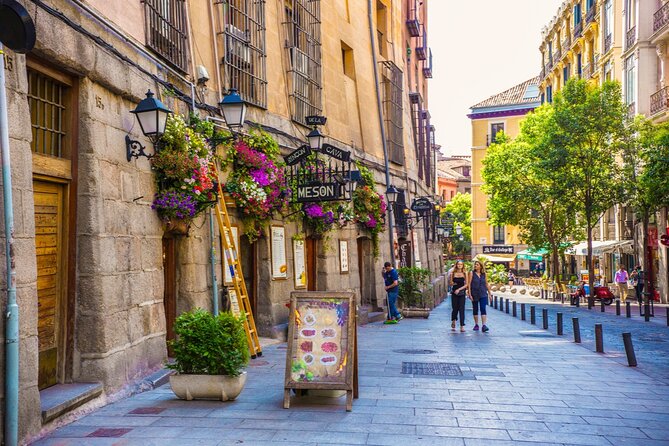
This experience works best if you want structure without being tied to a guide’s schedule. It gives you a route and a purpose, but you still move through Madrid under your own steam. The game takes about two hours, though the design lets you pause and continue later.
The route begins at C. del Marqués Viudo de Pontejos, near Madrid’s central plazas, and finishes at C. del Príncipe, in the middle of Plaza de Santa Ana. That makes the activity easy to fit into a day of sightseeing. You are not taken far from the historic core, and the stops build a picture of Madrid through public squares, religious buildings, and the people who shaped Spanish literature and art.
At each location, you look around for the answer to a prompt. Solving it sends you onward and gives you a little context about the place. This is not a lecture-heavy walking tour. It is closer to a city puzzle with historical information attached, which is why it can suit a family or a group of friends with different attention spans.
You will need a charged phone and the required apps downloaded before setting out. The game works offline, a useful detail if you do not want to rely on mobile data or a strong signal in every narrow street.
More Don Quixote Windmill Tours:
- Madrid: Don Quixote de la Mancha Windmills & Toledo Tour
★ 4.9 · 254 reviews - Tour of the Don Quixote Windmills of La Mancha and Toledo with Lunch
★ 5.0 · 209 reviews - Windmills of Don Quixote Wine Tour & Tasting from Madrid
★ 5.0 · 85 reviews
Plaza Mayor sets the tone
The first stop is Plaza Mayor, Madrid’s grand central public square. It was built during the reign of Philip III and once served as the heart of Old Madrid. The broad, enclosed space is an obvious place to begin, but the game asks you to look beyond the usual photo stop.
Your challenge here requires observation. Rather than simply reading a plaque or listening to a guide, you scan the square for the detail that answers the prompt. That small shift changes how you see the place. You begin checking facades, statues, signs, and corners instead of walking straight across.
The stop is listed as taking about 10 minutes, though the whole area invites a longer pause. If you visit at a busy time, give yourself room to work through the clue. Plaza Mayor is also only a few blocks from Puerta del Sol, so you are starting in one of the easiest parts of Madrid to reach by public transportation.
Puerta Cerrada adds a quieter historical layer
The route then moves to the area known as Puerta Cerrada. Its name preserves the memory of a gate in Madrid’s Christian wall, used during the Middle Ages and Renaissance. The gate was demolished in 1569 for the entry into the city of Isabel de Valois, wife of Felipe II.
This is a good example of what the game does well. The stop is not presented as one of Madrid’s grand headline sights. Instead, the clue gives you a reason to stop, inspect the surroundings, and connect an ordinary-looking urban space with an older chapter of the city.
The supplied directions do not provide a separate name or duration for this stop, so you should not expect a long visit. Think of it as a short street-level puzzle. If a building site or changed street arrangement affects the instructions, compare the prompt with what you can see around you rather than assuming your phone is always current.
A square shaped by banks, guilds, and demolition
Another stop concerns a square created in 1926 after several buildings around the old Customs Square and the adjoining La Leña area were demolished. Its story includes the Convent of the Trinitarios Calzados, the fish market of Almidón, and a seventeenth-century palace built for the Five Major Guilds.
That palace later became the property of the Bank of Isabel II. After that bank merged with the Bank of San Carlos, the building became the first headquarters of the Bank of Spain. Today, the building houses the General Directorate of the Treasury.
This is the sort of stop that can pass unnoticed if you are simply following the main sights. The game gives you a reason to examine the setting and think about how Madrid changed through demolition, finance, and government. You are not just collecting famous names. You are also seeing how the city’s streets reflect older institutions.
The information is dense for such a brief stop, so do not expect the game to explain every detail at length. If this part catches your interest, note the names and return later with more time.
More Madrid Tours:
- Madrid: Tour Bernabéu Entry Ticket
★ 4.5 · 21,573 reviews - Madrid: Prado Museum Entry Ticket
★ 4.6 · 17,509 reviews - Madrid: “Emociones” Live Flamenco Performance
★ 4.8 · 12,866 reviews - Madrid: Panoramic Route City Tour
★ 4.1 · 12,259 reviews
San Sebastián Church and Madrid’s literary quarter
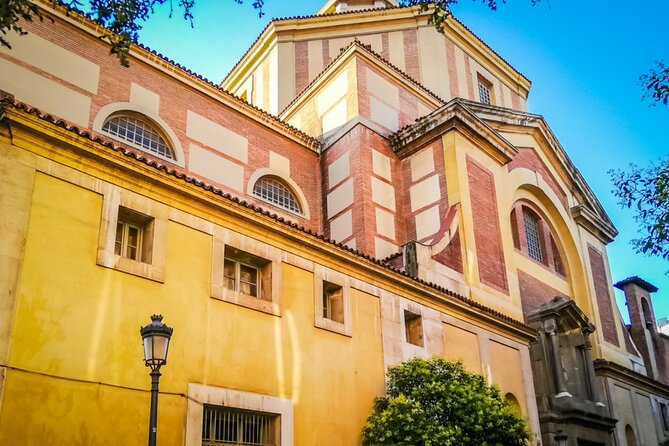
The route continues to the Iglesia de San Sebastián on Atocha Street. This sixteenth-century church takes its name from a devotional chapel along the route to the Basilica of Nuestra Señora de Atocha, founded in 1541.
Atocha Street helps shift the experience from broad public squares to a more intimate part of central Madrid. You are looking at a working city street, not a museum corridor, and that makes the clue-solving format useful. You have to stay alert to the details around you.
The church is another short stop rather than a full interior tour. The experience does not include a physical guide, and the information provided does not promise admission or a guided visit inside. Treat it as an exterior point on the route unless the app tells you otherwise.
Lope de Vega’s home gives the route a personal touch
The House-Museum of Lope de Vega is one of the route’s strongest literary stops. Lope de Vega, a major writer of Spain’s Golden Age, bought the sixteenth-century house in 1610. The building offers a link between a famous author and the domestic setting where he lived.
I like this part of the route because a writer’s home gives you a different kind of historical contact. A monument tells you that a person mattered. A house suggests how that person occupied daily life, even when the game only gives you a short introduction.
The experience does not state that museum admission is included, so you should not assume that the game provides entry. The challenge takes place as part of the outdoor route, and you can decide later if you want to return for a more detailed visit.
This is also a useful point to slow down. The advertised time is about two hours for the entire game, but the self-guided format means you can take longer at a place that interests you. You are free to pause, visit another sight, and resume later.
Cervantes brings Don Quixote into focus
The route then turns to Miguel de Cervantes Saavedra, the author of Don Quixote. His childhood home now houses a museum that recreates customs, traditions, and daily life from the sixteenth and seventeenth centuries.
The museum also holds a bibliographic collection with editions of Cervantes’ writing from different periods and in several languages. Its program includes workshops for children and teenagers, conferences, plays, and musical performances.
This stop explains the game’s title better than any broad reference to Spanish literature could. You are following a playful route connected to the writer most closely associated with Don Quixote, while also seeing the real places tied to his life and period.
Again, the city game itself should not be confused with museum entry. The supplied information describes the home and its exhibits, but it does not say that admission is part of the $8.40 price. If you want to visit inside, check the museum’s current arrangements separately.
For families, this can be one of the most useful points on the route. Children play free, and the challenge format can make a literary stop feel less like a forced school lesson. Adults still get the historical setting and the connection to Cervantes.
Cervantes’ burial place adds a surprising final note
The game also brings you to the convent where Cervantes was buried in 1616. During rebuilding in 1673, his remains were moved elsewhere and then lost. Forensic scientists identified them in 2015.
That story gives the route an unexpected twist. Cervantes is not only represented by a childhood home and a famous book. His burial place carries a mystery of its own, involving rebuilding, missing remains, and a modern scientific search.
The stop is likely to appeal most to readers who enjoy the human details behind famous names. You do not need to know Cervantes’ work in depth to appreciate the story, though an existing interest in Don Quixote will add extra meaning.
As with the other points, the game asks you to find an answer in the surroundings. Pay attention to instructions and signs, especially if construction has altered the approach. One known issue with the route is that some directions may be out of date, so flexibility matters.
Plaza de Santa Ana is a social finish
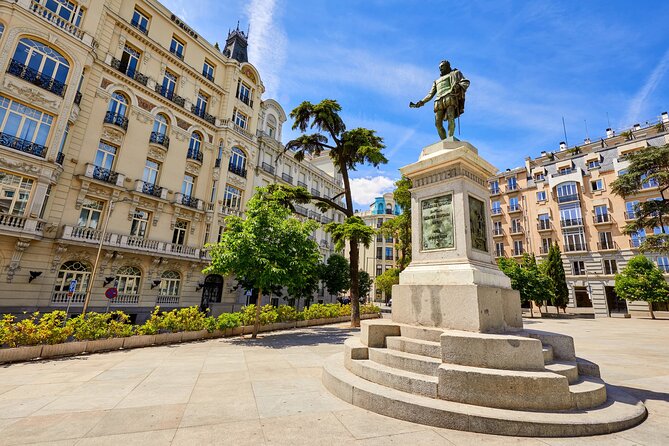
The city game ends in Plaza de Santa Ana, a lively central square filled with restaurants, cafés, and tapas bars. Its terraces cover much of the surrounding space, making it a natural place to sit after the final clue.
The square includes monuments to the Spanish Golden Age writer Pedro Calderón de la Barca and to poet and playwright Federico García Lorca. That makes the ending fit the route’s literary theme. You finish among writers rather than at a generic meeting point.
The end is given as the middle of Plaza de Santa Ana, reached by following the precise directions inside the app. This is practical because you can continue straight into a meal or drink, but it also means the activity does not return you to the starting point. Plan your next move from the square.
What $8.40 buys you
At about $8.40 per person, this is inexpensive for a two-hour activity in central Madrid. The value comes from access to a private route, a set of prompts, historical context, and the freedom to play at any time. You are paying for a digital experience, not a guide’s personal storytelling.
That distinction matters. If you want a live person to answer questions, explain architecture, and adjust the walk to your interests, this is not the right format. If you want a low-cost way to give your group a route and a shared goal, the price is easy to justify.
The group discount option may make the total even more appealing for larger parties. Kids play free, which improves the value for families. Since only your group participates, you also avoid the common problem of trying to keep a large walking group together.
The price does not appear to include museum admission, food, drinks, or a physical guide. Those costs are separate, so think of the activity as a self-guided outdoor game that passes several places you may later choose to visit in more depth.
Who will enjoy this format
I would choose this for a family that wants sightseeing to feel active rather than passive. The prompts give children a job to do, and the private format lets adults stop when needed. It also works well for friends who enjoy puzzles and want something more playful than a standard walking tour.
It suits independent visitors who dislike rigid departures. You can start at any hour, take a break, and resume later. The activity is available around the clock from Monday through Saturday during the stated operating period, January 25, 2021 through June 18, 2026.
It is also suitable for Madrid residents who want to notice parts of the center they usually pass without stopping. The route does not depend on being a first-time visitor. Its focus on street details, writers, and lesser-known historical connections can give familiar neighborhoods a new purpose.
I would hesitate to recommend it to someone who wants a polished, fully narrated history walk. The game depends on your own attention and phone, and one direction has already proved vulnerable to construction changes. You need to be comfortable solving a problem when the city does not match the screen perfectly.
The activity is near public transportation, and most people can participate. Service animals are allowed. Confirmation arrives at booking, and the experience is private for your group.
Timing, phones, and practical planning
Allow about two hours if you follow the route at a normal pace. You can take longer because breaks are allowed, but you should avoid treating the two-hour estimate as a fixed guided departure. The flexibility is the point.
Download what you need before starting. The game can be played without an internet connection, but your phone still needs enough battery for the route. Starting near the listed meeting point at C. del Marqués Viudo de Pontejos, 17, keeps you close to the first central sights.
Wear comfortable shoes. The route connects several locations in central Madrid, and the clues require you to look around rather than rush from one address to the next. If an instruction seems wrong, pause and inspect the area carefully. Construction, changed signs, or altered access can affect a digital route.
The cancellation terms are simple: cancel at least 24 hours before the start time for a full refund. Changes or cancellations inside that 24-hour window are not accepted for a refund.
Should you book the Don Quixote Quest?
Book it if you want a cheap, private, flexible way to explore Madrid through literature and local history. The route has a clear personality, linking Plaza Mayor with Cervantes, Lope de Vega, San Sebastián Church, and the writers remembered in Plaza de Santa Ana.
You should also book it if your group likes solving clues more than listening to a long talk. The offline play, free participation for children, and ability to pause make it easy to fit around a larger Madrid itinerary.
Skip it if you need a live guide, perfectly current directions, or detailed entry into every museum and church. At this price, you get a playful route and useful context, not a full private tour. For the right group, that trade is worthwhile.
FAQ
How long does the Don Quixote Quest Experience take?
The game takes approximately two hours. You can pause at any time and resume later.
Can I start the game at any hour?
Yes. The experience is available to book 24 hours a day, seven days a week, during the stated operating period.
Do I need an internet connection?
No. After downloading the required apps, you can play the city game offline.
Is a physical guide included?
No. This is a self-guided activity played through apps and prompts. A physical tour guide is not included.
Is the activity private?
Yes. Only your group participates in the activity.
Where does the game start?
The starting point is C. del Marqués Viudo de Pontejos, 17, Centro, 28012 Madrid, Spain.
Where does the game end?
The game ends in the middle of Plaza de Santa Ana. The listed end address is C. del Príncipe, 2, Centro, 28012 Madrid, Spain.
Are children allowed to participate?
Yes. Children can participate for free.
What is the cancellation policy?
You can receive a full refund if you cancel at least 24 hours before the experience start time. Cancellations and changes made within 24 hours are not refunded or accepted.
Just added around Madrid
- Visit the National Archaeological Museum in Madrid★ 4.4 · 6 reviews
- From Madrid: Parque Warner Beach Water Park & Transport★ 3.9 · 14 reviews
- Madrid Wine Tasting, Flamenco Class and Pub Crawl★ 4.5 · 6 reviews
- Virtual Reality Experience Fun And Tickets & Imageen★ 5.0 · 12 reviews
- Visit to the Prado Museum★ 4.9 · 6 reviews
- Tuk Tuk Tour with Wine Test in Madrid★ 3.8 · 6 reviews
- Tuktuk historical tour of Madrid 1 Hr in a fun and original way★ 3.7 · 3 reviews
- Prado Museum VIP tour with an art Expert, tickets included★ 5.0 · 11 reviews
Don Quixote Windmill Tours, compared.
Don Quixote de la Mancha Windmills & Toledo Tour
Read our review →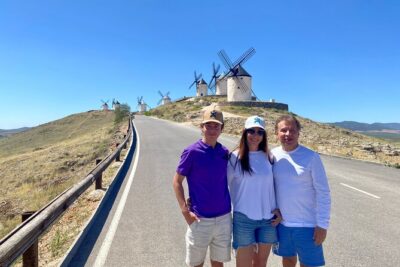
Tour of the Don Quixote Windmills of La Mancha and Toledo with Lunch
Read our review →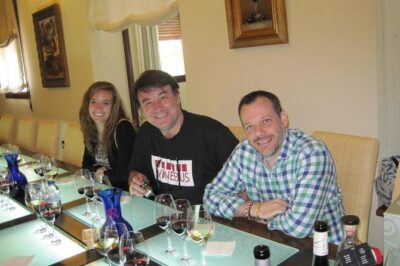
Windmills of Don Quixote Wine Tour & Tasting from Madrid
Read our review →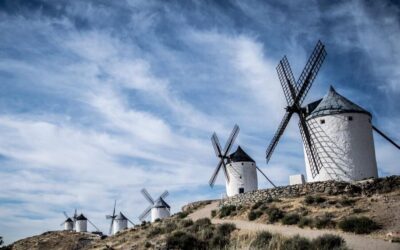
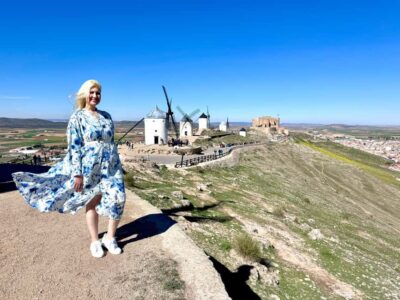
Toledo, Windmills, Winery Small Group Tour with Lunch from Madrid
Read our review →
Influential Toledo & Bookish Consuegra, Full Day Tour from Madrid
Read our review →
Browse the lists this tour appears in